The name of Charles Darwin and his groundbreaking work, The Origin of Species, will forever be linked with
the Galápagos Islands. During his five-week stay in the
Enchanted Isles in 1835, it was the wildlife that he saw there that inspired him to develop his Theory of Evolution.
But along with his well-documented thirst for knowledge about the origins of the islands’ inhabitants, Darwin
had an appetite for them, too. Indeed, a lot of the wildlife he studied ended up on the dinner menu.
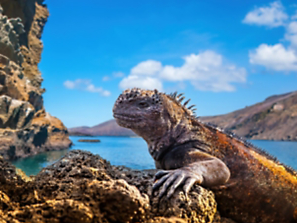
Marine iguanas are a common sight in the Galápagos—a species Darwin enjoyed not
only studying, but consuming.
To say that Darwin was an unusual gourmet is an understatement. He was never more content than when digesting the
rarest species known to the palate.
The origins of Darwin’s appetite for species
Darwin developed his exotic appetite at an early age. When he was a student at Christ’s College in Cambridge,
he presided over an organization called the “Glutton Club.” The sole purpose of this weekly culinary
gathering was to seek out “strange flesh” and consume the “birds and beasts which were before
unknown to human palate.”
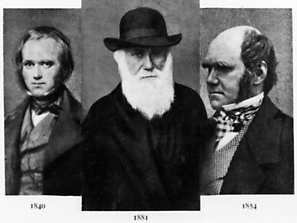
Portraits of Darwin throughout his years.
The club dined on things like hawk and a heron-like wading bird known as a bittern; but it didn’t last very
long. Apparently, an unpleasant experience with a brown owl carcass caused most of the members to drop out. Not
Darwin, though, whose appetite for “strange flesh” would continue to evolve …
Although he did quite well in his final exams, apparently Darwin’s first few years at Cambridge were not marked
by great academic achievements. He had already attended Edinburgh University to study medicine. His father had
wanted Charles and his brother to become physicians like he was, but Charles spent more time studying sponges than
medicine and left without a degree. Worried about his future, Charles’ father then decided his son should
pursue a clerical career and sent Charles to Christ’s Church in Cambridge—where he would spend more time
collecting beetles than studying theology.
Charles recounts one incident at Cambridge that illustrates his growing interest as an amateur naturalist—and
may even hint at his proclivity for dining on unusual foods:
“One day, on tearing off some old bark, I saw two rare beetles and seized one in each hand; then I saw a
third and new kind, which I could not bear to lose, so that I popped the one which I held in my right hand into
my mouth. Alas it ejected some intensely acrid fluid, which burnt my tongue so that I was forced to spit the
beetle out, which was lost, as well as the third one.”
Onboard the HMS Beagle—meals included
Not long after graduating from Cambridge, Darwin received a letter from a friend about an opportunity that would not
only change his life—but change history as well. The letter said that Robert FitzRoy was seeking a young
naturalist to accompany him on a two-year voyage to survey the coast of South America. The voyage almost
didn’t happen though. Darwin’s father thought that it would be “a distracting waste of
time” and quashed Charles’ dream before it even began. But Dr. Darwin was persuaded of the merits
of such a trip by Charles’ uncle, and the trip was back on.
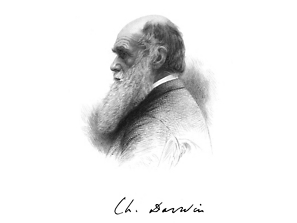
An illustrated portrait of Charles Darwin.
Darwin’s role was to be a private naturalist—and he would have to pay his own way (i.e., his father
would). The Beagle was a very small vessel—just 90 feet long and 24 feet wide. Darwin himself was
stunned at the cramped space he would call home for what would turn out to be not two years, but five years.
Although seasick most of the time, Darwin took to his role with unbridled enthusiasm. And it was a time when he was
able to indulge his penchant for unusual food choices. He was partial to iguanas and roasted armadillos, which he
said, “looked and tasted like duck”—along with a caveat that they “didn't make for a filling
meal when split between two people.” He also dined on puma, which he described as "remarkably like veal
in taste." And in the Galápagos Islands, he enjoyed feasting on giant tortoises. But he didn’t stop
there—he even drank the contents of their bladder. "The fluid was quite limpid,” he said, “and had
only a very slightly bitter taste."
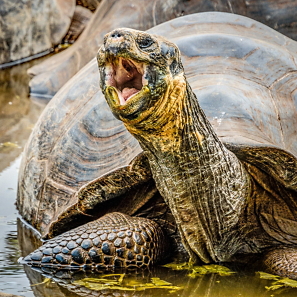
The poor tortoise that Darwin feasted on may have made a face like this when he
realized he and his bladder were on the dinner menu.
And in the “chef recommends” category, Darwin described a 20-pound rodent he dined on as "the very best
meat I ever tasted." While he didn’t identify his main course specifically, most assume it was an agouti, a
large rodent species native to Central and South America.
The ship’s chef was aware of Darwin’s penchant for unusual food choices and indulged him throughout the
voyage. His only culinary faux pas occurred when Darwin realized the chef had prepared an ostrich-like bird called a
lesser rhea. Charles had spent months trying to catch the rare flightless bird in order to scientifically describe
the species—and now he was eating it. Once he realized what he was dining on, Darwin is said to have leaped on
the dinner table and gathered all the remains he could for research, including “the head and neck, the legs
and many of the larger feathers.”
One has to wonder, though, if the HMS Beagle had an actual beagle on board, whether or not Charles would
have eaten it …
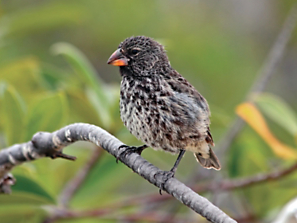
The finches found on the remote islands of the Galápagos helped Darwin form his theory of
natural selection and evolution.
By the way, while Darwin was feasting on giant tortoises in the Galápagos, he didn’t have a
“eureka” moment regarding natural selection and his future groundbreaking theories. It wasn’t
until the Beagle returned to England, when he had a chance to sort his specimens and classify
them, that he began figuring it all out. With the help of other experts, he eventually realized that each island was
home to its own finch species, that the marine and land iguanas were unique in the world, that much of the flora was
unique to the island chain, and that many species were unique to individual islands. And then, viva la
evolution!
A few more fascinating facts you may not know about Charles Darwin
- So, did Darwin believe in God?—It seems strange that a man studying for the priesthood
would develop evolutionary theories that conflicted with the church’s creationist teachings. But despite
his scientific allegiance, Darwin wasn’t an atheist. After the Beagle returned to England in
1836, he began looking into ways that science and evolution and religion and God could coexist.
- Mom, I think you’ve met Emma—While it was less taboo in Darwin's time than today,
Charles married his first cousin, Emma. Before they tied the knot, Charles made an analysis of the pros and cons
of matrimony. His pros included "children,” “constant companion,” and “charms of music
and female chit-chat.” On the cons side, he listed “loss of time” and “less money for
books.” The pros outweighed the cons, however, and the couple remained married for 43 years until
Charles’ death in 1882. Still, for someone who was well aware of the role of genetics in natural
selection, it was an odd choice for Darwin to marry a first cousin.
- But who’s keeping score? Darwin was a backgammon buff. Because he suffered from a
mysterious illness for much of his adult life, he tried to fight the symptoms by following a strict daily
schedule in his later years, which included two games of backgammon with his wife every night between 8 and
8:30. Like the scientist he was, Charles meticulously kept score, once boasting that he had won "2,795 games to
her piddling 2,490."
- The real reason why Darwin quit medicine—Perhaps the biggest reason Darwin left Edinburgh
and a career in medicine was that he couldn’t stand the sight of blood. Many people are squeamish about
blood, but when you factor in the brutality of 19th-century surgery, there was no way Darwin was going to make
it as an MD.
- Darwin wasn’t raised in a log cabin, but …—Darwin and U.S. President Abraham
Lincoln were both born on Feb. 12, 1809. Darwin, sort of like Lincoln, was also a firm abolitionist and
frequently wrote of his wish to see the practice end. After witnessing slavery during his travels in South
America, Darwin called it a "monstrous stain on our boasted liberty.” He wrote in 1833, “I have seen
enough of slavery to be thoroughly disgusted."
- Better late than never department—Darwin’s views on evolution via natural
selection didn’t sit well with the Church of England, of course. Nevertheless, more than 125 years after his
death, the church thought it was time to offer an apology for the way they treated the legendary naturalist.
Part of it read: “Charles Darwin: 200 years from your birth, the Church of England owes you an apology for
misunderstanding you and, by getting our first reaction wrong, encouraging others to misunderstand you still
… Good religion needs to work constructively with good science—and I dare to suggest that the
opposite may be true as well." Amen.
- Charles, put out the lights, wait, NO!—When Darwin was a student at Christ’s
College in Cambridge, he is said to have used his shotgun to blow out candles. His room can still be viewed and
includes his original beetle cabinet, bird skins, insect sweeping nets, a microscope, a double-barreled
percussion gun, and his stuffed dog, Sappho.
Visit the Galápagos and behold the same endemic species that Darwin studied (and ate) during
O.A.T.’s Ultimate Galápagos Exploration & Ecuador's Amazon Wilds
adventure.


