
O.A.T. travelers can try to time up their Heart of India departure to attend Holi’s main event—when locals take to the streets to douse each other with colored powder and water.
Embrace the essence of spring with these five global festivals—where the spirit of rebirth, renewal, and joyous celebrations mark the arrival of the season.
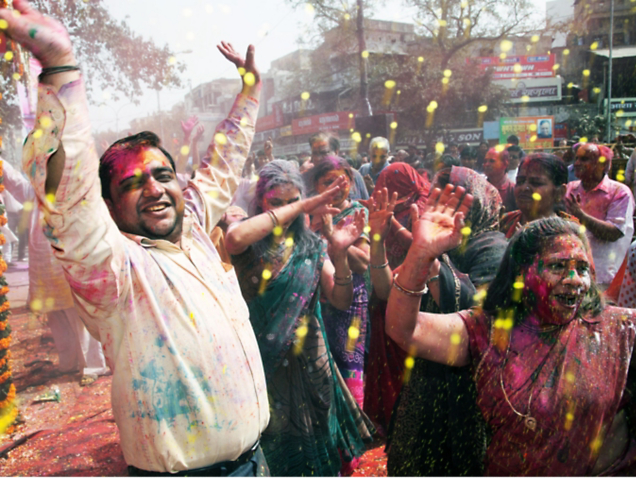
When? Holi takes place for two days during the Hindu month of Phalguna (which corresponds with late February or March) upon the arrival of the full moon.
Where? While celebrations happen all over the world, Holi is by far most popular in India, with slight variations depending on the region. For example, in West Bengal, it begins a day earlier.
What’s the story? The earliest mentions of Holi have been found in Hindu texts dating back to the fourth century. It may have begun as a prosperity ceremony for married women, but its evolution into a celebration of the triumph of good over evil has roots in Hindu mythology. In one legend, a demon king is outraged by his son’s worship of Vishnu, and attempts to kill him by fire with the help of his sister, Holika. While Holika wore a cloak to protect herself from the fire, it protected the boy instead, and Holika burned to death. Then, Vishnu killed the demon king, cementing the victory of good over evil.
Another legend explains the significance of color during the festival. Krishna, who is always depicted with blue skin, fell in love with a fair-skinned milkmaid. Self-conscious of his skin tone and ever the prankster, Krishna leveled the playing field by coloring the milkmaid’s skin, which evolved into the color-throwing tradition of today.
How is it celebrated? While the first night of the festival begins with a bonfire and prayers, the main event is the color-filled celebration the following day. Locals take to the streets and joyously douse each other with colored powder and water, with each hue bearing its own significance: blue for the god Krishna, green for rebirth, red for marriage and fertility, yellow for prosperity.
Embark on our Heart of India adventure in late February or March for a chance to experience the Holi festival firsthand.
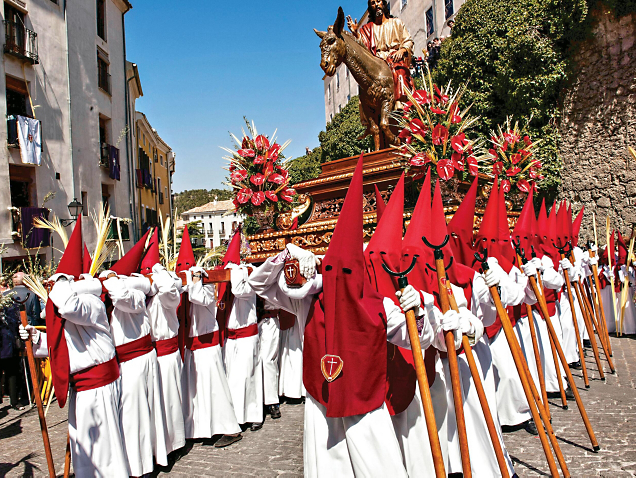
When? Semana Santa (Holy Week) takes place during the week leading up to Easter, from Palm Sunday to Easter Sunday.
Where? There are parts of the Semana Santa tradition that are common across the whole country. However, certain cities have their own unique way to celebrate Holy Week—such as Seville, Spain.
What’s the story? In the 16th century, the Catholic Church decided that believers should express their appreciation for the story of Christ through outward displays of devotion. Since then, townspeople have participated in the various processions and vigils that continue today. Seville's processions during Semana Santa have remained largely unchanged; the celebration unfolds today much as it did five centuries ago.
How is it celebrated? As one of the city’s most important holidays, schools, certain workplaces, bars, and restaurants close. Everyone has the day off to partake in the festivities and the whole city takes to the streets to appreciate the spectacle, with processions that can last up to 12 hours. In Seville, enormous statues and floats—known as pasos—make up the processions, each an artistic representation of some part of the story of the Passion of Christ (the story of Jesus Christ's arrest, trial, suffering, and execution by crucifixion).
The people who walk the processions and hold up the floats are performing an act of penance, repenting their sins—in Seville’s culture, doing this is a privilege. Other participants in the processions include the nazarenos, carrying bags of sweets and handing out candy to kids, who wear a unique dress—white robes accompanied by a conical hood (capirote)—born from a desire to repent sins without revealing your identity. Meanwhile, women wear la mantillas—beautifully woven lace veils—while the best local performers are given the honor of singing la Saeta, a traditional religious song.
Go on our Back Roads of Iberia: Spanish Paradores & Portuguese Pousadas adventure during Holy Week (usually in late March or early April) for a chance to experience Semana Santa firsthand.
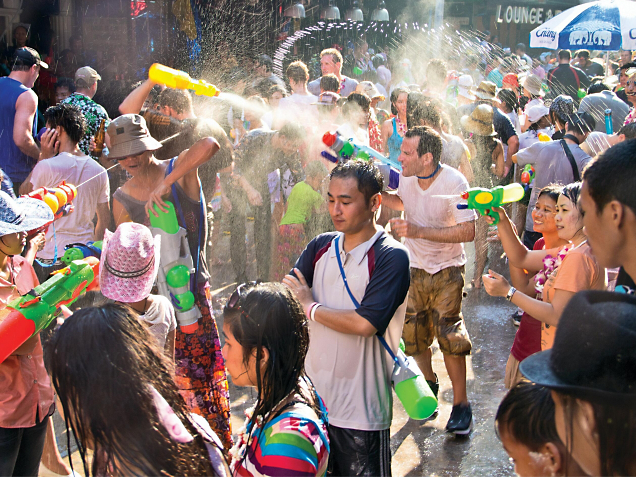
When? Songkran rains down annually from April 13-15, in accordance with the traditional Theravada Buddhist New Year.
Where? Festivities occur throughout Thailand, but Bangkok is home to the most raucous celebrations—particularly along the main thoroughfare of Khaosan Road. In quieter cities like Chiang Mai, or even at Bangkok’s temples, you can see more traditional interpretations of cleansing rituals.
What’s the story? Songkran did not begin as a relentless water fight. The true meaning is to symbolically wash away misfortune and welcome the new year with a clean slate. Over the years, these peaceful traditions have evolved (or devolved?) into a country-wide free-for-all in which buckets, hoses, and water guns are deployed to inflict the most powerful soaking possible.
Why? For one, this is the hottest time of year in Thailand. But it’s also just plain fun.
How is it celebrated? According to tradition, on the first day of the festival, scented water is poured over Buddha images as a form of purification. On the second day, young people pour scented water over the hands of their elders as a sign of respect and make offerings to monks at local temples. While these traditions still take place in quieter areas, they have been largely overshadowed by street parties accompanied by music and dancing.
If you do plan on visiting Thailand during Songkran, know that resistance is futile. You can purchase waterproof pouches and goggles from street vendors to protect your phone and your eyes. Do your best to keep water out of your mouth to avoid getting sick.
Embark on our Ancient Kingdoms: Thailand, Laos, Cambodia & Vietnam adventure in mid-April for a chance to experience Songkran firsthand.
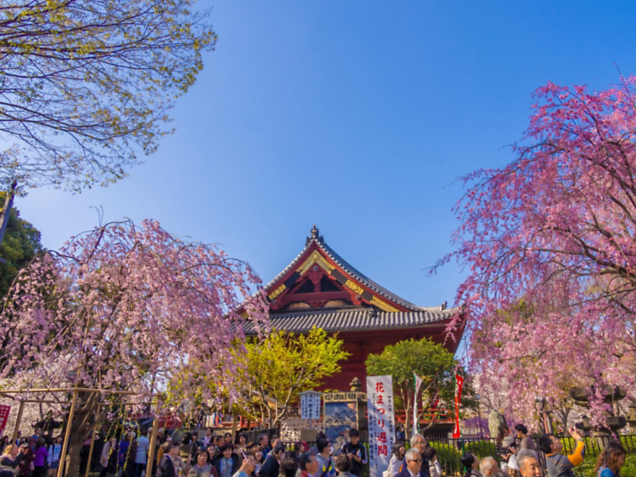
When? The arrival of cherry blossoms season signals the end of chilly winter weather in Japan, starting towards the end of March and lasting until the beginning of May.
Where? The blossoms start to bloom first in Kyushu around the end of March and spread northward as the weather warms, reaching Tokyo in early April and Hokkaido in mid-May.
What’s the story? In Japan, the ancient tradition of enjoying the beautiful but ephemeral blossoms of cherry trees is called hanami, which literally means "flower viewing." As early as the Nara period (710–794 AD), people in Japan celebrated the arrival of spring with cherry and plum blossom-viewing parties. Members of the imperial court at that time would gather to appreciate the fleeting beauty of the delicate pink and white sakura.
How is it celebrated? Today, people from across Japanese society congregate under the cherry trees to informally enjoy food, drink, and perhaps music with family, friends, or coworkers while sitting on plastic sheets or picnic mats spread upon the ground.
The best spots for blossom viewing are in high demand, and the competition is stiff. Many workplaces send the new employee or intern to stake out a good location early in the morning or even the day before. Some companies offer volunteers a half day off work to reserve a spot. Families and groups of friends also arrive at parks to reserve a nice patch of ground for later. In the afternoon, people leave work or home to gather around the trees, bringing with them ample treats for a relaxed picnic.
Customary foods include bento box lunches, hanami dango (sweet tricolored dumplings), and sakura mochi, an iconic confection of pink sticky rice filled with red bean paste and covered with a pickled cherry leaf. College students and office workers often bring plenty of sake (rice wine) or beer, and by evening the picnic becomes a party. In some locations, the trees are lit with floodlights or lanterns when darkness falls, and the party goes on well into the night. This is called yozakura, or "night sakura."
Go on our Japan's Cultural Treasures adventure between late March and early May for a chance to experience Hanami firsthand.
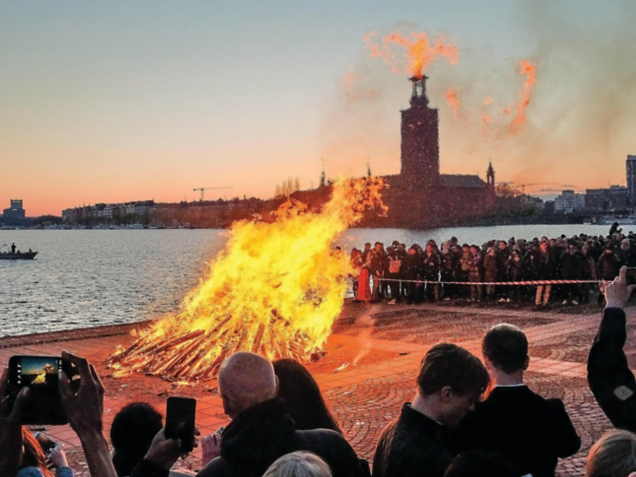
When? This traditional holiday is celebrated annually on April 30.
Where? Northern Europe and Scandinavia.
What’s the story? The origins of the holiday date back to pagan celebrations of fertility rites and the coming of spring. After the Norse were Christianized, the pagan celebration became combined with the legend of St. Walburga, an English-born nun who lived at Heidenheim monastery in Germany and later became the abbess there, believed to have cured the illnesses of many locals.
Walburga is traditionally associated with May 1 because of a medieval account of her being canonized upon the translation of her remains from their place of burial to a church circa 870 AD. Although it is likely that the date of her canonization is purely coincidental to the date of the pagan celebrations of spring, people were able to celebrate both events under church law without fear of reprisal.
How is it celebrated? Initially, Walpurgis Night was celebrated by the Finnish upper class. Then, in the late 19th century, students (most notably engineering students) took up its celebration. Today, merrymaking begins on the evening of April 30, often augmented with the drinking of alcoholic beverages—particularly sparkling wine. The carnival-like festivities carry over to the next day, frequently taking on a family dimension, as friends and relatives will picnic in parks among balloons while consuming sima—a homemade low-alcohol (and sometimes not so low-alcohol) mead.
In Sweden, typical holiday activities include the singing of traditional spring folk songs and the lighting of bonfires. In Germany, the holiday is celebrated by dressing in costumes, playing pranks on people, and creating loud noises meant to keep evil at bay. Many people also hang blessed sprigs of foliage from houses and barns to ward off evil spirits, or they leave pieces of bread spread with butter and honey, called ankenschnitt, as offerings for phantom hounds. In Finland, Walpurgis Night and May Day are effectively merged into a single celebration that is usually referred to as Vappu—which is among the country’s most important holidays.
Embark on our Fjord Cruise & Lapland: Norway, Finland & the Arctic Circle adventure in late April for a chance to experience the Walpurgis Night firsthand.
2025 Holiday Sailings: 5 Departures to Celebrate Christmas or the New Year with O.A.T.
Here are 5 holiday departures to celebrate Christmas or the New Year with O.A.T.
8 Fall Festivals Around the World
Here are eight of our favorite ways to mark autumn, wherever our travelers are.
April Fools’ Day: History, Hoaxes & Ill-Fated Hijinks
Explore the origins of this prank-filled holiday—and history's most notorious hoaxes.
Get The Inside Scoop On...
Like what you see here? Receive weekly updates right in your inbox.
inside-scoopArticles In This Edition

Around the World in 5 Spring Festivals

Exploring Iceland: Highlights & Hidden Gems with Our Regional Office

Petal Pushers

Where in the World?