
Pamela Keene at the temple of Ta Prohm during our Ancient Kingdoms: Thailand, Laos, Cambodia & Vietnam adventure, which was famously featured in "Raiders of the Lost Ark."
Pamela Keene at the temple of Ta Prohm during our Ancient Kingdoms: Thailand, Laos, Cambodia & Vietnam adventure, which was famously featured in "Raiders of the Lost Ark."
Pamela Keene is a journalist who first published this story in Lakeside News, her home news website. We reprint it with permission here.
By Pamela Keene, 23-time traveler from Flowery Branch, GA
World history from my teenaged years became reality—places, faces and events—when our three-week journey to Southeast Asia took me to Cambodia and Vietnam. Terms like “The Killing Fields,” “Ho Chi Minh Trail,” and “jungle warfare” were words in newspapers and magazines in the late 1960s and early to mid-1970s, not connected with real locations and other human beings.
The Vietnam War—they call it the American War—was tragic in so many ways but I won’t go into that here.
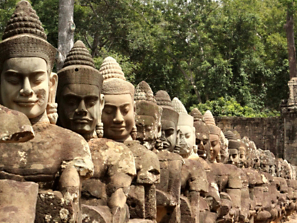
The details in the carvings at Angkor Wat are just as impressive as its massive scope.
From Vientiane, Lao, we flew to Phnom Penh, Cambodia, and the Champey Academy of Arts where a group of children ages 6 to 18 performed traditional Aspara dancing, filled with delicate, precise and hard-to-mimic hand, finger, arms, toes, leg, and feet positions. The dances were beautiful and the costumes colorful. However, the most amazing part of the visit came afterwards, when dozens of these children told us about their lives, many speaking excellent English.
The school’s founder, Californian Mark Rosasco, told us stories of the children who were rescued from the streets, many orphaned and HIV-positive, who now live at the school and receive education in arts and culture. A former banker, he told me that this was his calling, to “make up for his time on Wall Street,” and his commitment to the future of Cambodia and its people is undeniable. “The mission of our foundation [Kasumisou Foundation, www.kasumisou.org] is to preserve the traditional crafts skills of the people of Cambodia and work on behalf of the poor in Southeast Asia,” he explained. To see and speak with these children and learn about the foundation’s work was a high point of our visit to Cambodia and Phnom Penh.
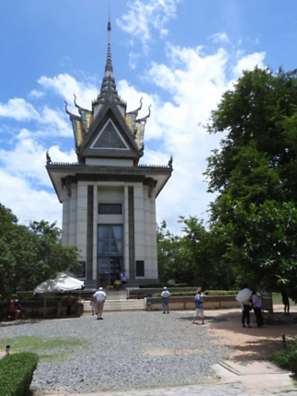
This Buddhist temple at the Killing Fields in Cambodia was built to honor the victims.
Our tour leader Leky, who traveled with us from country to country, kept telling us that our journey would show us the “good, the bad and the ugly” of Southeast Asia. We’d seen bits of all three in Thailand and Lao, but a sobering half-day at the Killing Fields followed by an intimate conversation with an 85-year-old survivor of the 4-year-long genocide of more than 1.7 million Cambodians truly brought the “bad and ugly” home.
When the Khmer Rouge, and its leader Pol Pot, rose to power in 1975, their mission was to eradicate the intelligent and educated. Hundreds of thousands of teachers, doctors, lawyers, businesspeople, and their families—men, women and children—were rounded up, tortured, killed, and dumped into mass graves, some with as many as 1,000 bodies. Chum Mey, his wife, and four children were imprisoned; he never saw them again.
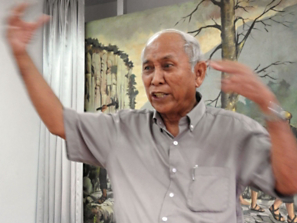
Chum Mey, a survivor of the Khmer Rouge genocide, tells his story.
We walked through S-21, a former school, and saw the tiny cell where he was shackled to the floor, unable to lay flat or move for days at a time with no food, no water. Queried relentlessly by the Khmer Rouge soldiers about his supposed connections with the CIA, he was repeatedly tortured. After 12 days and nights of beatings, he was brought to the offices of the leadership where he worked repairing the very typewriters that documented the torture and death of his friends and fellow Cambodians.
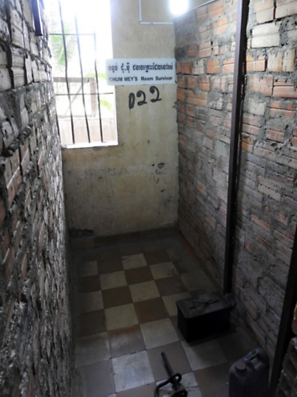
Chum Mey’s cell, where he was shackled to the floor for days at a time.
Chum Mey is a miracle whose stories are captured in Survivor: The Triumph of an Ordinary Man in the Khmer Rouge Genocide. When Chum Mey learned that I was a journalist, he asked that I tell his story so that people would know what really happened during those four years in Cambodia. Also, if you haven’t seen it lately, watch “The Killing Fields,” starring Sam Waterson and John Malkovich. The Cambodian man who played their interpreter actually survived the genocide, escaped to America, and was cast by Hollywood producers as a survivor. He, too, has an amazing story.
A small plane took us to Siem Reap in the northern part of Cambodia to one of the most anticipated tours of our trip: Angkor Wat, the ancient city built in the ninth century, first as a center for Hinduism and later adapted by the Buddhists. As one of the World’s Seven Wonders, the holy city of Angkor Wat covers 96 square miles and is surrounded by a moat that’s 570 feet wide. It’s a mere four miles north of Siem Reap.
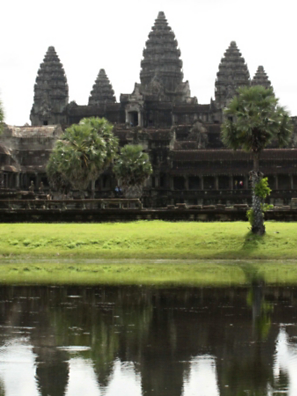
The intricate temples of Angkor Wat reflected in the surrounding moat.
Its sheer mass and size is breathtaking. The centerpiece is the large pyramid temple with five towers. At one time covered with gold, today its thousands of bas relief carvings and sculptures remain to show the incredible craftsmanship and intricate detail. A walk to the third level via narrow stairs is rewarded with spectacular views of the countryside and the many auxiliary buildings that comprise the city.
We toured several other nearby historic sites, including the “Raiders of the Lost Ark” temple, officially called Ta Prohm, and saw its iconic root-bound ruins. The area is rich with ancient ruins, including Angkor Thom city and Bayon Temple.
Our trip ended with a flight to Ho Chi Minh City, formerly known as Saigon, in southern Vietnam. Once again in a bustling city, we lunched at the ultra-modern, multi-story Vincom shopping mall, one of the country’s largest, filled with American-trademarked products and cafes offering international foods. Our orientation tour took us to the streets where thousands of helmet-clad scooter drivers dodged traffic, weaved between lanes of cars and took short-cuts along sidewalks to be the first at traffic lights.
We visited the brick replica of Notre Dame Cathedral across the street from the post office, a former train station. The Ben Thanh Market, a sprawling enclosed market in District 1, sells everything from local crafts and fine jewelry to ready-to-eat foods, shoes, clothing, and just about anything else you can imagine. A full day in the market isn’t enough time to do it justice.
In the countryside, we experienced the famed Cu Chi Tunnels, an expansive underground network of multi-level subterranean rooms connected by more than 125 feet of tunnels, much like an ant farm. Built by the Vietcong to aid in troop movement and ambush fighting, the tunnels are only about three feet in diameter. We had to bend from the waist and bend our knees to travel from a room designed for cooking to another where a makeshift clinic tended to wounded soldiers in the war.
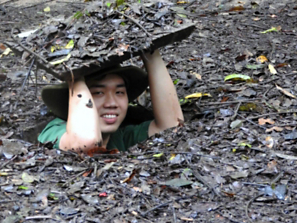
Once Vietcong soldiers descended into the Cu Chi Tunnels, their entry points were nearly invisible.
Throughout our travels, we were constantly reminded of the importance of Southeast Asia’s many rivers. The Mekong winds its way from China to the sea at the southern end of Vietnam, so our final day was spent navigating the river, canals, and the surrounding area known as the Mekong Delta. We visited a roadside open-air coffee shop—move over Starbucks—where locals lounged in nylon-rope hammocks, and a coconut farm where they made coconut sugar candy. Our riverside lunch featured whole fresh-caught fish, a “dragon’s egg” made from deep-fried sticky rice paste, and the typical selection of fresh cooked vegetables and rice.
As is the tradition with O.A.T., our group gathered the last night for a farewell dinner at a local restaurant. It was our final time together; we exchanged white elephant gifts we’d purchased along the way, recalled stories of our journey, and exchanged contact information. There were no sad goodbyes, just plenty of hugs and smiles as we began to turn our thoughts homeward and a return to “normal” life.
The long plane ride home—five hours from Ho Chi Minh City to Seoul, Korea, then 14 hours from Seoul to Atlanta—gave me plenty of time to reflect on my visit half way around the world to places I’d only heard about. It was indeed a trip of a lifetime and as I review my notes and photographs, I continue to remember all the people, the places, the emotions, and the wonders of the other side of the glove.
Experience the many facets of Vietnam and Cambodia—the good, bad, and ugly—with O.A.T. during Ancient Kingdoms: Thailand, Laos, Cambodia & Vietnam.
Get The Inside Scoop On...
Like what you see here? Receive weekly updates right in your inbox.
inside-scoopArticles In This Edition

Giving Back in our Backyard: Community Service in Boston

Grand Circle Foundation Update: Baan Pakklongrua Primary School

Top 10: Most Popular NEW Journeys for 2025

Vietnam & Cambodia: The Other Side of the Glove

Where in the World?