Kwibuka means "To Remember," honoring the memory of more than one million Rwandans who died in the hundred days of the Genocide against the Tutsi in 1994—a tragic event that travelers can learn extensively about during our Rwanda: Mountain Gorillas in the Land of a Thousand Hills adventure.
Rwanda—a small East African country—has spent nearly three decades rebuilding itself after the 1994 genocide, one of the most rapid and brutal genocides in modern history.
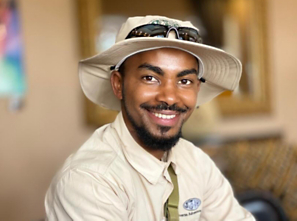
Ismail Nsengiyumva—an O.A.T. Trip Experience Leader for our Rwanda: Mountain Gorillas in the Land of a Thousand Hills adventure.
To explore these lessons, we spoke with Ismail Nsengiyumva—an O.A.T. Trip Experience Leader for O.A.T.’s Rwanda: Mountain Gorillas in the Land of a Thousand Hills adventure since 2021. Ismail has witnessed his country's evolution firsthand, and he was proud to share insights into Rwanda's past, its present, and the ongoing work of reconciliation. His account reveals a nation that—while still grappling with its painful history—has made remarkable strides towards unity and peace.. Ismail has witnessed his country's evolution firsthand, and he was proud to share insights into Rwanda's past, its present, and the ongoing work of reconciliation. His account reveals a nation that—while still grappling with its painful history—has made remarkable strides towards unity and peace.
Rwanda is a healing nation, making remarkable strides towards unity and peace since the 1994 genocide.
The roots of Rwanda's tragedy lie in its colonial past. Ismail explained, "Historically, the Hutu, Tutsi, and Twa groups coexisted in Rwanda for centuries, sharing the same language, culture, and religion. The differences between them were more socio-economic than ethnic, with the Tutsi often being cattle herders, the Hutu being farmers, and the Twa being hunter-gatherers."
Despite these distinctions, the groups intermarried and lived together peacefully. However, the arrival of colonial powers—particularly the Belgians—changed this dynamic. "Colonial powers deepened divisions by classifying and privileging groups based on these identities, which laid the groundwork for future conflict," Ismail said.
This "future conflict" would ultimately culminate in the devastating genocide of 1994—Rwanda’s "Darkest Hour." The colonial-era policies of ethnic classification and favoritism sowed seeds of resentment and inequality that persisted long after Rwanda gained independence in 1962. Over the following decades, political and social tensions between Hutu and Tutsi groups escalated—fueled by propaganda, economic pressures, and power struggles.
On April 6, 1994, these tensions exploded into full-scale violence when the plane carrying Rwanda's Hutu president was shot down. This event triggered a campaign of mass killings, primarily targeting Tutsis and moderate Hutus. Over the next 100 days, an estimated 800,000 to 1 million Rwandans were killed.
In the aftermath of the 1994 genocide, Rwanda faced the monumental task of rebuilding not just its infrastructure, but the very fabric of its society. Ismail highlighted some of the most crucial initiatives: "One of the most important efforts has been the Gacaca courts, community-based tribunals that brought justice to those involved in the genocide." These courts played a pivotal role in Rwanda's healing process. "The Gacaca courts allowed people to face their accusers, admit guilt, and seek forgiveness, which is crucial for moving forward," Ismail explained.
Beyond the justice system, Rwanda has implemented policies to support unity among its people, shifting its focus toward building a shared identity that has been instrumental in changing how Rwandans interact with one another. Ismail noted, "The government has emphasized a national identity over ethnic identity, with policies that promote 'Ndi Umunyarwanda' (I am Rwandan) as a way to unite all citizens." The impact of these efforts is evident in daily life: "Today, Rwandans are focused on unity and rebuilding the nation," Ismail said. "While wounds remain, there is a strong commitment to ensuring that the past is never repeated."
"The government has emphasized a national identity over ethnic identity, with policies that promote 'Ndi Umunyarwanda' (I am Rwandan) as a way to unite all citizens," Ismail told us.
Ismail shared a powerful personal anecdote that aptly illustrates Rwanda's progress: "During a visit to the Reconciliation Village, I met a survivor who lost her entire family in the genocide and a perpetrator who participated in those events. Today, they live side by side as neighbors, sharing meals and even working on projects together." He described this as "a powerful example of forgiveness and the long journey toward healing" and "a testament to the resilience and courage of the Rwandan people."
As a Trip Experience Leader for our Rwanda: Mountain Gorillas in the Land of a Thousand Hills adventure, Ismail often guides travelers through sites like the Kigali Genocide Memorial. He approaches these visits with care and sensitivity. "I emphasize the importance of remembering the past to prevent future atrocities, but I also highlight Rwanda's incredible progress since then," he explained. "I try to balance the conversation by focusing not only on the pain and suffering but also on the hope, resilience, and efforts that have been made to rebuild and reconcile."
Rwanda's experience offers valuable lessons for other countries facing similar challenges. Ismail pointed out, "One of the key lessons from Rwanda is the importance of justice and accountability in healing a nation." He also emphasized "the power of unity and the importance of focusing on common goals rather than divisions."
The path to reconciliation in Rwanda is still ongoing.
Despite the remarkable progress, Ismail acknowledged that Rwanda's journey is far from over. "While Rwanda has made remarkable strides, the journey is ongoing," he said. Looking ahead, he identified several key areas for continued focus: "Continued efforts to address the psychological trauma of survivors, particularly the younger generation, are crucial. Expanding economic opportunities and addressing any lingering inequalities will also be important. "Lastly, fostering an open society where people feel free to express themselves without fear is essential for long-term peace and unity," he said.
As Rwanda continues to move forward, its story serves as an inspiration to the world. Through justice, unity, and a commitment to shared identity, the nation has shown that it's possible to overcome even the deepest divides. While challenges remain, Rwanda's journey of reconciliation offers hope and valuable lessons for countries around the globe grappling with conflict and its aftermath.