
During Morocco Sahara Odyssey, seek out Jardin Majorelle for a peaceful respite from the bustling souks of Marrakesh.
During Morocco Sahara Odyssey, seek out Jardin Majorelle for a peaceful respite from the bustling souks of Marrakesh.
By Nancy Stamp, 11-time-traveler from Ithaca, NY
Our guide Malek enticed us with hints about delightful garden surprises in Marrakesh, but we really didn’t know what to expect. In an oasis in the Sahara, we’d visited a six-acre palm tree grove and nursery garden. The farmer’s father went to great lengths to find—using a dowsing rod—an area with "sweet water." Then they dug a well and irrigation ditches. The farmer had to monitor his plots daily. By hand, he re-positioned the continually shifting sand dunes that encroached upon his plantings.
Marrakesh, a 1,000-year-old oasis on the other side of the Atlas Mountains from the Sahara, is not in the desert. Nonetheless, the city has a hot, semi-arid climate, with an average rainfall per year of just ten inches, similar to that of Arizona.
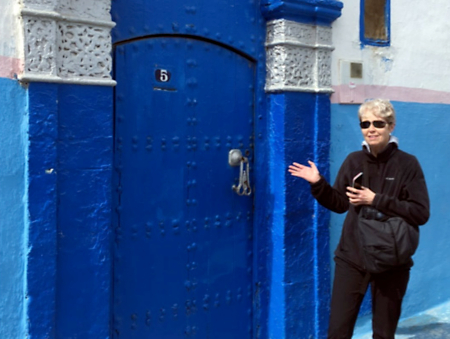
After a couple days in Marrakesh, now a modern city of about one million people—and thoroughly experiencing the Medina of Marrakesh (a UNESCO World Heritage site) with its souks of narrow alleyways crammed with vendors, shoppers, motor bikes, and donkey carts—we were ready for something different. A tranquil botanical garden sounded heavenly.
About two miles from the famous medina, and no longer on the outskirts of Marrakesh, is Jardin Majorelle. We entered a walled enclosure with winding footpaths shaded by combinations of palms, tree ferns, bamboos, and tree-like cacti. The understory with its array of globular and columnar cacti, plus agaves, yucca, and here and there pools with water lilies, provided even more foliage colors, shapes, and shadows. The plants were from semi-arid areas around the world, in particular North, Central, and South America.
But the first surprise wasn’t that there was such a garden here. Rather it was how the location of each plant, pot, and pool—the colors, lines, and shapes of them—seemed just perfect, no matter the viewer’s angle. Adding to that was the striking use of an intense, electric shade of cobalt blue, "Majorelle blue," on walls, doors, window frames, pools, and pots, as a unifying accent to the garden.
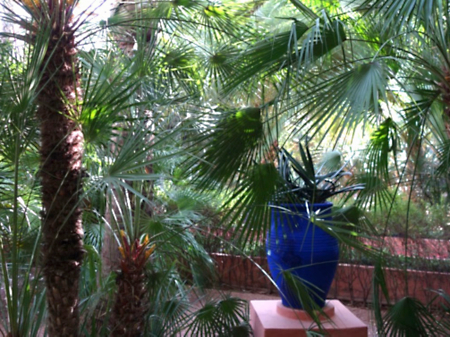
The garden was inspiration for Jacques Majorelle, a French artist (1886-1962) who settled in Marrakesh in 1919. He purchased four acres of a date palm grove (which meant there was a source of water) and began planting cacti, bamboos, bananas, tree ferns, and many varieties of palms. Eventually this "gardenist," as Majorelle called himself, expanded his plantings across ten acres.
Open-air artists, in particular the French Impressionists, delighted in capturing the changing effects of atmospheric lighting, especially in dry air, in which colors seem brighter across a landscape. The basic technique of impressionism, for example, as in Paul Cezanne’s work, consisted of the composition developing from the contrast of colors through painting, rather than by framing color in drawing and so outlining contours. That is, choice of colors substituted for line, shading and perspective.
Jacques Majorelle was enthralled particularly with the atmospheric light and colors of Morocco, but he didn’t choose the approach of the Impressionists. Instead, his painting relied on simplified drawing, often subjects outlined; contrasting patterns of dark, light, and local colors; more poster-like with stylized forms. In fact, he also created travel posters that dramatized the exotic and vibrant outdoor life in Morocco.
Here was my second surprise. Majorelle had applied his painting method to landscaping—using the colors of Moroccan tiles, lighting of the arid atmosphere and his sense of contrasting geometric forms. He treated his entire garden as a three-dimensional composition. His artistic alternative to that of the French Impressionists worked extremely well in his garden.
However, with the high maintenance costs of the garden, and even after opening it to a paying public in 1947, eventually Majorelle had to sell the land. Fortunately, in 1980, the French designers Yves Saint-Laurent and Pierre Bergé discovered the badly neglected garden. Bergé recalled they fell, "in love with a small, mysterious garden, painted in the colours of Henri Matisse," secluded from the noise of the city and the wind of the arid plains. They bought it and began restoration of Jardin Majorelle, with the help of Madison Cox, a landscape designer. Today the garden has 300 plant species and an automatic irrigation system, and is visited by 800,000 people a year.
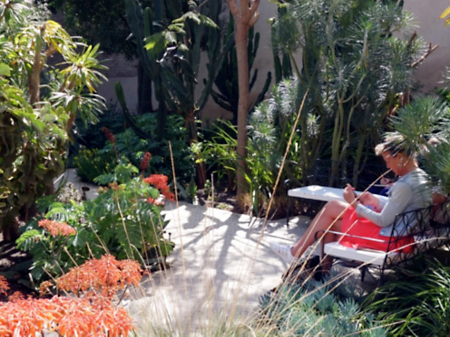
My third surprise occurred at Le Jardin Secret. It was tucked away in the medina (the old city of Marrakesh) and … walled by two riad-type complexes … We passed through an archway into an exotic city garden, an "oasis of the desert" with plants from around the world. Adjacent to that was an Islamic "oasis of peace" garden modeled on eighteenth-century design, which reflects the Quran’s description of heaven as "gardens, with rivers flowing beneath." Here, people meandered quietly and took advantage of the many secluded benches for reading and meditation, provided by the thoughtful placement and height of plants. Again, a source of water was a key element for Le Jardin Secret. The original water system for Marrakesh dated back to the eleventh century, when a tunnel was constructed from the city to an aquifer, supplied by drainage from the Atlas Mountains.
What I experienced in Le Jardin Secret and Jardin Majorelle differed from what I felt in city gardens elsewhere. In today’s world with internet and cell phones, we easily lose the art of "being in the moment." The design of these Marrakesh gardens captures one’s attention in a way that focuses and so quiets the mind. The essence of these Marrakesh gardens is that each is an oasis of serenity.
Witness these awe-inspiring gardens for yourself during free time or during our Marrakesh Museums optional tour on O.A.T.’s Morocco Sahara Odyssey adventure.
Thankful in Morocco
When this traveler visited Morocco during Thanksgiving, an unexpected challenge left him with a lot to be grateful for.
Lingering Grains of Thought on the Desert
Relive the inspiring experience this traveler had in the Sahara Desert in Morocco.
Where in the World?
Where in the world is this tranquil oasis, once owned by a famous fashion designer?
Get The Inside Scoop On...
Like what you see here? Receive weekly updates right in your inbox.
inside-scoopArticles In This Edition

Marrakesh’s Hidden Gardens

No Cars Allowed: Our Favorite Pedestrian Zones

Tails of Tradition: Ireland's Sheepdogs at Work

Unreal Estate

Where in the World?