
Sydney’s Royal Botanical Gardens always offer beautiful views of the city skyline—and only very occasionally a foul-smelling odor likened to death—as you can discover during A South Pacific Odyssey: Australia, the Outback & New Zealand.
Question: What city’s botanical gardens drew more than 20,000 fans for a whiff of a foul-smelling flowering plant that finally bloomed after 15 years?
Answer: Sydney, Australia
Aussies who had been holding their collective breath for more than a decade finally had the chance to hold their noses instead when a rare "corpse flower" bloomed at the Royal Botanical Gardens in Sydney this past January. On the day of the anticipated event, tension filled the air until the five-foot-tall plant, set on a dais and surrounded by velvet ropes like a rock star, slowly began to unfold. Then something else filled the greenhouse air—the sickly-sweet odor of decaying, rotting flesh. And the crowd loved it.
Even more extraordinary, the endangered "corpse flower" hadn’t bloomed in Australia in fifteen years. Yet there would be three separate flowerings at botanical gardens in a three-month span—one near Melbourne and another in the nation’s capital of Canberra—which all attracted similar crowds. With plants raised under different conditions at each location, botanists are at a loss to come up with an explanation for Australia’s recent spate of putrid blooms.
While Australia supports a mind-boggling diversity of indigenous plant species—with a high proportion of them found nowhere else in the world—the corpse flower isn’t one of them. The plant is native to the equatorial rainforests of Sumatra, Indonesia, and it was Indonesians who gave them the name bunga bankai, which means "corpse flower."
A rose by any other name …
As Sydneysiders were waiting for the momentous bloom of their corpse flower, they gave it the affectionate nickname of "Putricia" (combing Putrid with Patricia). But we don’t have to resort to childish names like that or even "corpse flower" when referring to this rare flowering plant. Let’s instead give it some dignity and call it by its scientific name Amorphophallus titanium, which is Latin for … "giant, misshapen penis." Okay, maybe we’ll just stick with "corpse flower."
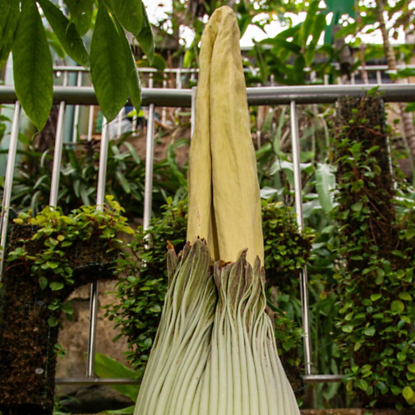
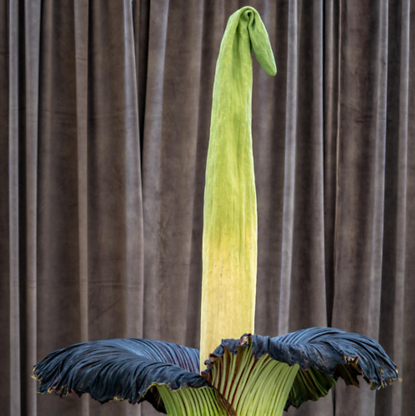
What’s in a scientific name? Look no further than "Putricia"—shown here both before and during blooming.
But whatever we choose to call it, the "corpse flower," as just mentioned, hails from the Indonesian island of Sumatra, where there are thought to be only about 300 of the plants left in the wild. The tropical plants grown here can reach up to 9 feet high and 4 or 5 feet in diameter. In its natural habitat, it blooms for just a few days every two to five years, up to five times in its lifetime.
So, why the stink? The rancid scent is nature’s way for the plant to attract pollinators like flies and other insects—who, let’s face it, find the aroma of rotting garbage irresistible. Instead of attracting pollinators with sweet smelling nectar like most flowers, the corpse flower is more of an "anti-flower," luring pollinators with carrion-like odors. Because the plant is so large and produces such powerful smells, it takes an inordinate amount of time and energy for it to blossom—which explains the long wait for optimal growth conditions between blooms.
Cultivating an obsession for the foul-smelling flower
Ever since the "discovery" of this rare and unusual flower in 1878 by Italian botanist Odoeardo Beccari, the corpse flower has captivated the world. The first one to ever bloom through cultivation took place in London in 1889. Cultivated corpse flowers in recent years have grown even bigger than those in the wild. One at the botanical gardens of The Huntington in San Marino, California (called "Stankosaurus Rex") was more than eight feet tall. The world record holder is a specimen that measured more than 12 feet tall.
Even though corpse flowers have been successfully cultivated in greenhouses and botanic gardens around the world, the blooms are still extremely rare—in fact, it is thought that fewer than 200 have been observed in cultivated corpse flowers since 1889. Because of this, research is still in its infancy. There is lot that botanists still don’t know about how and why this botanical wonder does what it does—but they’re sniffing around for the answers.
One often hears the corpse flower referred to as "the largest flower in the world," but it’s actually an inflorescence—which is a fancy way of saying that it’s made up of hundreds of tiny flowers inside the base of its stem. Once nature decides that the corpse flower is ready to bloom—anywhere from two to 15 years—the process of "unfurling" takes about 12 hours. With its signature stench at its most powerful, the flower stays fully bloomed for several hours. It takes another 12 hours for the flower to collapse into itself and, well, that’s it—it dies.
It shouldn’t be surprising that the world has been fascinated by this botanical oddity for more than a century. Some botanists have been known to wait their entire lives to witness the blooming of a corpse flower. When you consider its enormous size and the ephemeral nature of a bloom that reeks of death, who can blame them? For true corpse flower aficionados, you could say the aroma isn’t the problem—it’s the waiting that stinks.
Evolutionary oddballs
With an astonishing 24,000 species of native plants, Australia is home to a stunning variety of beautiful flowering plants in every shape, size, and color of the rainbow. But mentioning iconic flora like Kangaroo Paws, Golden Wattles, and Flannel Flowers isn’t really in keeping with today’s theme, now, is it? As you can imagine, Australia is home to more than its share of botanical oddities as well.
For one thing, the continent is home to more carnivorous plants than anywhere else on earth. In fact, there are some 250 species of these evolutionary oddities that are endemic to this ancient land mass. Due to Australia’s soil having gone relatively undisturbed for millions of years, it is not very nutrient rich—creating the ideal conditions for plants to evolve and adapt to their environment. And for many, that meant going carnivore, because a plant’s gotta eat, right?
A few of Australia’s predatory plants and other botanical oddities
While you’re unlikely to catch a whiff of Putricia within the next decade—sorry not sorry?—you can experience plenty of Australia’s fascinating flora and fauna during A South Pacific Odyssey: Australia, the Outback & New Zealand.
Airwave Academy
In which country does the "world's largest classroom" span a continent, host royalty, and conduct lessons through thin air?
Where in the World?
Where in the world is this scenic gap, home to black-footed wallabies and—once upon a time, according to the local aboriginals—a group of giant reptiles?
Wonder No More?
More than 90% of what watery wonder may disappear within ten years?
Get The Inside Scoop On...
Like what you see here? Receive weekly updates right in your inbox.
inside-scoopArticles In This Edition

Death Petal

NEW Trip: Southern Africa Discovery: Victoria Falls, Kruger Safari & the Cape Peninsula

Psst… Tell Your Friends! Top 10 Most Popular Adventures for First-Time O.A.T. Travelers

Where in the World?