
Between the first Sunday of Advent and New Year’s Day, defenders of the Gävle Goat are vigilant at nightfall. Discover the ancient Norse roots of many modern Swedish traditions during our Grand Baltic Sea Voyage Small Ship Adventure.
Question: A giant straw statue of what Scandinavian Yule figure has been a recurring target of arsonists in a Swedish town?
Answer: Goat
The Goat has been a Scandinavian Yuletide symbol and Christmas tradition for millennia. While its exact origins are lost in the mists of time, it is believed to be connected to Thor, the mighty thunder god of Norse mythology, who traversed the sky in a chariot pulled by a pair of magnificent goats. Celebrated in pagan festivals as a harbinger of harvest season in pre-Christian times, the Yule Goat eventually became intertwined with Christian holiday traditions—first, as a frightening creature who demanded gifts, then as the bringer of Christmas gifts, and finally as a Rudolph-type animal that helps out Santa Claus (the name for Santa in Finnish is Joulupukki—meaning Yule Goat).
In modern times, a decorative Yule Goat made of straw and bound with red ribbons remains a popular Christmas tree ornament in Nordic countries. Larger versions of the goat ornament are even frequently erected in towns and cities around the holidays—but nothing like the 45-foot-tall Yule Goat statue in Gävle, Sweden. For 60 years, a massive straw statue—known as the “Gävle Goat”—is erected in the town’s main square to mark the beginning of the holiday season. And for at least 35 of those 60 years, it has met with a fiery death as the result of being torched by arsonists. It got so bad that wagers began being placed on whether the goat will make it to Christmas because, without fail, someone will try to burn it down.
To be clear, its destruction is not an officially sanctioned part of the beloved Gavle Goat holiday tradition—something an American tourist should have known in 2001 when he set the goat on fire and then had to spend 18 days in a Swedish jail. Almost all incidences of goat vandalism have been committed under cover of night and—with the notable exception of that ill-informed American—most of the perpetrators have managed to escape.
Yule logs are meant to be burned, not Yule goats
It seemed like a great idea in 1966, when the town of Gävle decided they wanted something fun and festive to dress up their town square. It probably didn’t occur to them that a giant statue made of highly flammable straw might prove a tempting target for vandals. Still, the inaugural Gävle Goat—all 45-foot-high and three tons of him—made it all the way to New Year’s Eve before being burned down. It wouldn’t be the last time.
In 1970, the Goat had been up for just six hours before being set ablaze by two inebriated teenagers. In 1972, it imploded due to “unknown sabotage.” In I973, a local man stole the Goat and installed him in his own backyard (a stunt that cost him two years in prison). 1976, a student rammed the Goat with his car, causing its hind legs to collapse. More incidences followed, but the destruction of the Gävle Goat remained a local news story until 1995, when a Norwegian man crossed the border in a failed attempt to burn it down. And in 2001, after that American tourist (from Cleveland, Ohio) successfully burned down the Goat, it became international news.
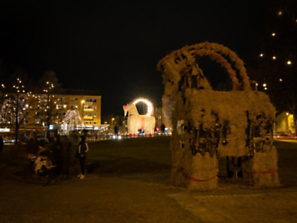
In 2019, the Gävle Goat survived—but a smaller, unofficial version placed nearby could sadly not say the same.
The town initiated all kinds of measures to protect their Goat. They stationed guards around it, had security cameras installed, built fences around it, and even began spraying it with flameproof chemicals. But the Goat burners would not be deterred. In 2005, a group of “unknown vandals” dressed in Santa Claus and Gingerbread Men outfits shot flaming arrows at the Goat. In 2008, after two unsuccessful attempts to burn down the supposedly flameproof Goat, vandals succeeded on their third attempt on December 27th at 4 am.
Increased security just gets their goat
In 2009, after the town had installed a 24-hour webcam to deter would-be arsonists, the system was knocked offline by hackers and the Goat was torched under cover of darkness on December 23rd. The following year, one of the men entrusted to guard the Goat refused a large bribe to leave his post so a helicopter could fly in to steal the Goat—which made it all the way to New Year’s Day intact that year.
After the Goat burned down in 2015, the town took extra precautions to ensure the Goat’s safety for the upcoming year, which marked the 50th anniversary of the first statue. The Gävle Goat was unveiled on November 27th—and went up in flames that very same night. It was replaced by a second Goat, which was then hit by a car.
Then, in what some have called a Christmas Miracle, the Gävle Goat made it through four years in row unscathed. Others give credit to the K-9 unit hired by the town for thwarting several attempts. The streak ended in 2021, however, when the Goat was burned to the ground yet again—this time by a 40-year-old man who was captured and sentenced to six months in prison.
Currently, the Gävle Goat is being protected by 24-hour security guards who patrol the perimeter non-stop, two security fences, closed circuit cameras, and a team of volunteers around the world who watch a streaming image of the Goat to detect the first sign of vandalism. It probably won’t be enough, though. With a track record like that, the Gävle Goat must be one of the most critically endangered species on the planet …
Ten fascinating facts about Christmas you may not know
Delight in the rich folkloric traditions of Sweden—no open flames required—during Grand Baltic Sea Voyage.
A Local's Guide to Copenhagen's Food Scene: Inside Torvehallerne Market
Natashja—who began her career as an O.A.T. Trip Experience Leader in 2018—shares her passion for Danish cuisine.
Hygge and Lagom—A Guide to Scandinavian Living
How coziness and balance helps bring joy to harsh winters.
Get The Inside Scoop On...
Like what you see here? Receive weekly updates right in your inbox.
inside-scoopArticles In This Edition

Confection Connection: How Ecuadorian Cacao Elevates Belgian Chocolate

Do You Want to Build a Snowman?

Something Special: Exclusive Itineraries by Sea & River for 2026

Survey Says: Improving How We Gather Traveler Feedback … and Why it Matters

Yule Fuel