
A bonsai display in the Shanghai Botanical Garden—which you might opt to visit during free time in the city when you join us for New! China’s Imperial Cities, Natural Splendor & Modern Marvels.
Question: The ancient practice of bonsai—the cultivation of miniature trees or plants in small containers—has its “roots” in what country?
Answer: China
Almost everyone associates bonsai trees with Japan, of course. But while bonsai cultivation has been a Japanese cultural touchstone for more than 1,400 years, it didn’t originate there. The practice was passed along to Japan from China, which had been engaging in the cultivation of trees and other plants intended as a miniature representation of nature for centuries. In more recent times, bonsai are celebrated as living works of art both in Japan and around the world.
The seeds of bonsai were planted in China …
The practice of bonsai cultivation began in China sometime between 500 and 1,000 BC. Its origins were likely the result of explorers observing trees and plants that were growing high in the mountains of China—where the climate and harsh growing conditions produced trees that were extremely small and gnarled in appearance. For centuries, Taoists had believed that recreating aspects of nature in miniature gave people access to special powers, so they attempted to recreate the stunted trees they saw in the high-altitude mountain landscapes.
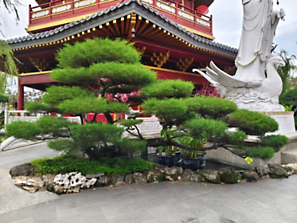
A bonsai outside a Chinese temple.
The Chinese then developed pruning and binding techniques to give their plants twisted shapes and an aged appearance to simulate the natural trees they found in the mountains. They displayed these miniature landscapes on earthenware containers which became known as “punsai” or “penjing”—which basically means “plant” or “landscape” in a “pot.” The first archaeological evidence of punsai was discovered in a tomb dating from 200 AD whose wall had a mural depicting female servants carrying a display of miniature trees.
… and later spread to Japan
For several hundred years, punsai cultivation flourished in China, although it was reserved for the elite in Chinese society. Then, in the seventh century, Buddhist monks from Japan brought back examples of punsai from China—as well as the techniques required for creating them. It would come to be known as bonsai in Japan—pretty much the same meaning though, a “tree in a pot.” The Japanese would develop their own methods for producing the dwarfed trees, which would result in different shapes and styles than China’s punsai. First found only in monasteries, by the 14th century, Japan’s bonsai trees were considered a highly respected art form. As symbols of status and honor, they became fixtures in homes of the elite, just like in China.
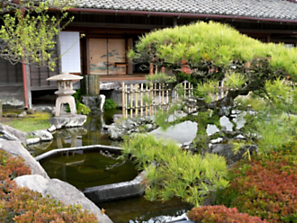
A bonsai display in a Japanese home garden.
Japan’s earliest bonsai trees typically reached a height of one or two feet, requiring several years of expert care. To achieve the twisted appearance of the branches and trunks, bamboo and wire were used to hold the tree in the desired shape as it grew. Cultivators often grafted new branches onto existing ones to create a specific shape. But at the beginning of the 1600s, a new philosophical outlook in Japan resulted in bonsai cultivation “branching off” in a different direction. Reflecting Japan’s “less is more” minimalist thinking, artisans began employing special pruning techniques to remove all but the essential elements of bonsai trees.
No longer exclusively for the elite, Japanese bonsai trees became available to all social classes—which meant more people had to learn the art of bonsai cultivation. Soon, bonsai trees were fixtures in almost every Japanese home. Instead of status symbols, bonsai trees are now seen by most people as symbols of harmony, balance, and patience—or simply as living components of interior design. Zen Buddhists consider bonsai trees as objects of meditation or contemplation.
Bonsai in Japan, punsai in China—what’s the difference?
We mentioned how Japan’s bonsai tradition originated in China. But while bonsai and punsai share similar concepts, there are significant differences between the two art forms. The biggest one is that China’s punsai creations are often entire miniature landscapes. In addition to trees, they might include rocks, figurines, and even water elements. The main focus of bonsai in Japan, however, is trees.
What kind of trees? The most common bonsai tree in Japan is the pine, a conifer tree or shrub with a cluster of two to five needles. The one with five needles is called a Japanese White Pine. Other trees used in bonsai are the Japanese Maple, Juniper, and Cherry. The easiest to maintain and go-to plant for bonsai beginners is the Ficus.
The first pruning of a young bonsai is what determines the tree’s ultimate shape. The strategic placement of wires will make the trunks and branches turn in the desired direction. Grafting is often used to create a new bonsai, add branches or roots, or replace foliage. The most common styles in Japanese bonsai cultivation include chokkan, which is just like a tree would grow in nature; moyogi, similar to the chokkan except the trunk grows in the shape of the letter “S”; kengai, where the tree grows downward; and yose-ue, with several trees planted in one pot.
Bonsais—the long and the short of it …
As you can imagine, bonsai trees come in all shapes and sizes. The smallest class of bonsai is known as keshitsubo, which is often nicknamed the “poppy-seed” class. This category includes a famous miniature Japanese Maple bonsai that stands about a half-inch tall, complete with tiny leaves that change color in autumn. So small that the pot can be balanced on your fingertip, growing a bonsai at this scale takes enormous dedication.
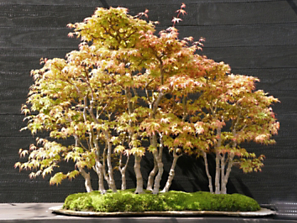
A Japanese Maple bonsai displaying autumn foliage.
A micro-bonsai like the Japanese Maple wouldn’t survive a week without constant attention to its needs. But with proper care, traditional bonsai trees can live a remarkably long time, often outliving their caretakers. We’re not talking just years, but centuries. A Sargent Juniper bonsai still going strong in Japan is estimated to be about 1,000 years old. You can see this living treasure for yourself at Omiya Bonsai Village in Saitama, Japan. Another seasoned veteran is the Shimpaku Juniper bonsai, which can be viewed at the Shunka-en Bonsai Museum in Tokyo. With its twisted, gnarly trunk, it actually almost looks its age—which is estimated to be around 800 years—but it was designed precisely that way.
A few more fascinating facts about bonsai trees
Be on the lookout for Chinese examples of punsai and other cherished artistic traditions during our New! China’s Imperial Cities, Natural Splendor & Modern Marvels adventure.
Space Added to Meet Demand: New! China's Imperial Cities, Natural Splendor & Modern Marvels
From giant pandas in their natural habitat to the legendary Terra Cotta Army, this adventure offers a perfect blend of cultural immersion, natural wonders, and authentic local encounters.
The "4 Great Inventions" from Ancient China That Shaped the Western World (and Several More That May Surprise You!)
From gunpower to paper to the compass to the printing press and more, here are four inventions from Ancient China that shaped the Western World.
Stone Dragons and Concrete Giants: China's Two "Great Walls"
China's ancient Great Wall kept invaders out for centuries, but can its modern counterpart—the Three Gorges Dam—keep the Yangtze River in check?
Get The Inside Scoop On...
Like what you see here? Receive weekly updates right in your inbox.
inside-scoopArticles In This Edition

A Plea for your Assistance

Most Popular O.A.T. Adventures in Asia

Navigating the Organized Chaos of Saigon's Streets with Shirley Lang

Rags to Riches

The Khmer Empire—Succession, Golden Age, and Influence

Tree Trimming