
Tunisia’s date harvest offers a unique glimpse into a way of life that has remained largely unchanged for centuries—travelers have the opportunity to witness it on our Tunisia: From the Mediterranean to the Sahara adventure.
Question: Which North African delicacy, known as the "bread of the desert," has been sustaining communities for millennia in an annual harvest festival?
Answer: Dates in Tunisia.
Each autumn, the annual date harvest breathes life into the arid oases of southern Tunisia, transforming them into bustling hubs of activity as generations-old communities unite to gather their most cherished crop—the date, aptly nicknamed the "bread of the desert" for its vital role in sustaining local life. Rich in natural sugars, fiber, potassium, and various vitamins and minerals, dates have sustained desert communities for millennia. In times of scarcity, they have been a crucial food source, capable of being stored for long periods without spoiling.
Unlike many crops, the date palm (scientifically known as Phoenix dactylifera), thrives in the harsh desert climate of southern Tunisia. These resilient trees can reach heights of up to 75 feet and live for over a century, producing fruit for decades. The most prized variety of Tunisian dates is the Deglet Noor, which translates to "Date of Light" in Arabic. This golden-hued fruit is revered for its sweet flavor, tender texture, and translucent appearance when held up to the sun.
Fall’s harvest season ushers in colorful festivals hosted by Tunisian locals, where the air fills with traditional music and the swirling of folk dances, while an impressive array of date-based delicacies tempts visitors from across the globe. These festivals allow visitors to observe skilled date-pickers demonstrating their craft, participate in tastings of various date varieties, and even join in lighthearted date-eating contests.
The harvest itself requires quite a show of bravery from Tunisian farmers—climbing the tall date palms without modern equipment is a dangerous task that requires years of experience. Using nothing more than a rope belt wrapped around their waist and the trunk of the palm, harvesters scale the trees with remarkable agility. Once at the top, they carefully cut down the heavy clusters of dates, each weighing up to 20 pounds.
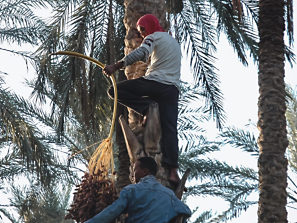
The date harvest requires quite a show of bravery from Tunisian farmers.
As the fruit is brought down from the trees, a flurry of activity ensues on the ground. Women and children often take charge of sorting the dates, separating them by quality and preparing them for sale or storage. The best dates are destined for export markets, while others are preserved for local consumption throughout the year.
The tradition of date harvesting in Tunisia stretches back to ancient times, with historical records suggesting its origins as early as 5000 BC. So central were dates to the region that the Romans—who once ruled this North African land—referred to Tunisia as the "land where the dates grow." Today, Tunisia stands as one of the world's leading date producers (see the "Fun Facts" section below), with the fruit playing a vital role in both the country's economy and cultural identity.
Unfortunately, the date industry faces challenges in the modern era—including climate change and water scarcity. However, Tunisian farmers and agricultural experts are working to develop sustainable practices to ensure the continuation of this ancient tradition. Efforts are being made to improve irrigation techniques, introduce drought-resistant date palm varieties, and explore new markets for Tunisian dates.
7 Fun Facts About Dates:
Discover how dates are used in Tunisian cuisine Tunisia: From the Mediterranean to the Sahara adventure.
Where in the World?
Where in the world is this whitewashed village, built around the tomb of a Muslim saint and a source of inspiration for some of the greatest creative minds in history?
Where in the World?
Where in the world is this whitewashed village, built around the tomb of a Muslim saint and a source of inspiration for some of the greatest creative minds in history?
Get The Inside Scoop On...
Like what you see here? Receive weekly updates right in your inbox.
inside-scoopArticles In This Edition

8 Fall Festivals Around the World

Date Night

From Child Bride to College Grad: An Update on Flora, a Maasai Student

Visit the Adriatic in the Autumn and Winter to see Stunning Colors and Sights

Where in the World?