
Learn about the threats to Tanzania's lion population, and how the country strives to protect them, during Safari Serengeti: Tanzania Lodge & Tented Safari.
Save $500 on ANY 2027 departure
Learn about the threats to Tanzania's lion population, and how the country strives to protect them, during Safari Serengeti: Tanzania Lodge & Tented Safari.
Of all the Big 5 African mammals—lion, leopard, elephant, Cape buffalo, and rhinoceros—seeing the "king of the jungle" in the wild is a special thrill, whether you’re observing a choreographed hunt or listening to a fearsome roar. Yet no animal’s ferocity can combat the human-created threats of poaching and habitat loss, which causes concern for safari guides like Trip Experience Leader Emanual Munisi.
Since 1900, the global lion population has dropped dramatically from around 200,000 to just 30,000. But he has hope for the survival of the species. "There has been an increased focus on conservation," he says. "The government has employed more park rangers and pays them good salaries and incentives."
But in countries like Tanzania, where humans must learn to coexist alongside wildlife, cooperation from government officials and park employees is only the beginning. "Education has helped bring awareness amongst the communities around conservation areas," he says, noting that locals understand the economic benefit of healthy wildlife populations. "There is employment for locals through construction of lodges and camps, and this is because of travelers who come see the species."
As a result, he says, "it has become easier to see lions while on safari these days compared to some years back." Around half of the world’s lions reside in Tanzania, with 3,000 living in the Serengeti. "Because the species is not poached in most areas, they do not get afraid of our vehicles," Emanuel says. "This helps travelers see them quite close without the animals running away."
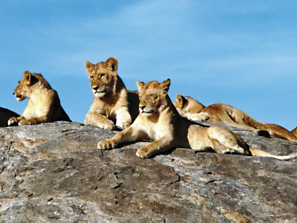
Lions use the Serengeti’s rocky outcroppings both for protection and views of prey.
The ease of spotting makes the Serengeti one of his favorite places to see lions—especially due to large rock formations called kopjes. "They use the rocks as a lookout perch for prey animals," he says. "They also give birth on the rocks because they provide good places to hide their cubs for security, and good shade on hot days."
Another favorite spot is Ngorongoro Crater—a collapsed volcanic caldera where many species live year-round without the need to migrate. "Ngorongoro is a small area with open vegetation, which allows for easy spotting," he says. "It has plenty of food and water, and the crater walls are difficult for poachers to navigate." The crater encapsulates an impressive variety of landscapes within its 102 square miles, including a lake, river, swamps, forest, hills, and mountains, as well as vast open plains.
The enclosed nature of Ngorongoro, however, has created a unique threat to the lion population there: inbreeding. The problem began with a massive die-off in the 1960s due to a plague of biting flies, leaving behind just one male and nine females. Over the ensuing decades, only seven new lions entered the crater, the others likely deterred either by steep walls or territorial behavior.
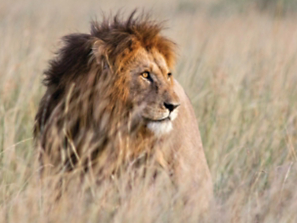
The territorial nature of male lions has created an unfortunate problem in Ngorongoro.
"Today, there are three male lions cooperating to defend their territory by not allowing new lions to enter the crater from other parts of Ngorongoro or even the Serengeti," Emanuel says. "So these lions have been mating with their daughters, granddaughters, and so forth. According to a lion researcher I spoke to, there used to be five males, but two died. The three remaining have been dominating the crater for the past seven years."
So what can be done? "The lions could be removed from the crater and relocated to other conservation areas," he says. "Then new male lions could be brought in that are not related to the lionesses."
In general, Emanuel believes the lion species can be saved by increasing awareness—which has already seen success in the Serengeti. "We can avoid human-wildlife conflicts by not taking livestock into corridors used by lions." In the unfortunate event that a lion does kill livestock, humans often retaliate by killing the lion. Instead, Emanuel says, "they should involve the government and seek compensation."
Other measures include criminalizing all hunting of lions, employing more park rangers and veterinarians, and conducting more research on lion behavior. And conservation, of course, should not stop with lions. "Herbivores must also be protected," says Emanuel. "These are the lions’ food, so the more of them there are, the better the lions’ survival rate."
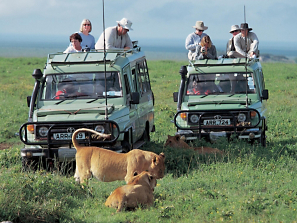
Lions do not fear safari vehicles, making close encounters possible.
With conservation measures firmly in place, Emanuel hopes to guide his travelers to thrilling lion encounters for years to come. He recalls some of his own favorite sightings: "I happened to witness a new male taking over a territory after fighting the dominant male, who lost," he says. "I have also had lions kill close to my tent in the Serengeti at night, and I could hear them chewing the bones."
But not all lion encounters are quite so gruesome. "I have seen a female lion moving very small babies in her mouth to a new place because of safety," he says. Seeing lions with cubs during calving season (from January to mid-March in the Serengeti) is always a joy for travelers.
The Serengeti and Ngorongoro are just two reasons to visit his beautiful country of Tanzania, from snowcapped Kilimanjaro to the spice island of Zanzibar. But he never tires of seeking out lions—the rightful king of all predators with an uncertain yet hopeful future.
Discover the wildlife of Tanzania with the help of a skilled Trip Experience Leader like Emanuel during Safari Serengeti: Tanzania Lodge & Tented Safari.
Where in the World?
Where in the world can you find the "little brother" of elephants and manatees, who more closely resembles a woodchuck, oversized guinea pig, or rabbit?
Read the Beads
Where can beads reveal a person's marital status, village size, religious beliefs, and more?
Pretty in Pink
What colorful bird species found in Ngorongoro Crater turn their heads upside down to eat—and live in corrosive waters that will burn the skin of most animals?
Get The Inside Scoop On...
Like what you see here? Receive weekly updates right in your inbox.
inside-scoopArticles In This Edition

Embrace Your Wild Side: Immersions Adventures in Nature

Fowl Play

On Trend: Top 10 Journeys by Land, Sea & River

Protecting the King: Emanuel Munisi on the Future of Lions in Tanzania

Ultimate Australia with Lisa