In the video above, let Uugan-Erdene Khurtsgerel, Trip Experience Leader for our Mongolia & the Gobi Desert adventure, share his love of Mongolian wrestling and learn more about its importance in his nation's culture—including its customary clothing, and its pre-match rituals—during a demonstration in Ulaanbaatar.
Mongolia's Naadam Festival is an annual celebration of traditional sporting events which take place in Ulaanbaatar and in many rural villages during Mongolia's national holiday in July. Naadam (which simply means "festival") is a time when Mongolia's finest athletes participate in the country's "three sports of men."
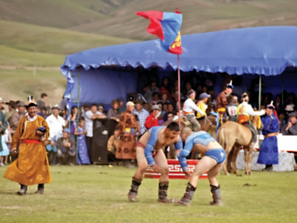
During the Naadam Festival, Mongolia’s finest athletes participate in the country’s "three sports of men"—the most popular of which is Mongolian wrestling.
"The Naadam festival is an ancient annual celebration of Mongolian culture and the nomadic lifestyle," Uugan-Erdene explained. "Also, it celebrates the warrior spirit which Mongolia is famous for. This festival highlights three traditional warrior sports—wrestling, horse racing, and archery—with wrestling being the most widely followed. Thousands of wrestlers, organized into their provincial wrestling clubs, compete to earn titles and, importantly, bring honor to their hometowns."
Mongolian wrestling isn't the same sort of wrestling we’re familiar with in America—this competition utilizes a combination of skill and strength where the first opponent to touch the ground loses. As Uugan-Erdene put it, "The rule is simple: no kicking, no punching, just touching the ground first with any part of your body except your hands results in a loss."
During the Naadam Festival, Mongolian wrestling is a single-elimination, untimed tournament that consists of 512 to 1,024 wrestlers who grapple for nine or ten rounds. Only men are allowed to compete, and the wrestler with the greatest fame gets to choose his opponent. Victors are known as arslan, or "lion," and two-time winners get to be called avraga, or "giants."
"Since wrestlers are considered the epitome of Mongolian men, they are treated with dignity and respect," Uugan-Erdene told us. "In my opinion, it teaches us how to respect and listen to elders, how to be humble, how to assist the weak and how to wear traditional costumes with grace."
One particularly meaningful tradition is the falcon dance. "Wrestlers do the movements of the falcon, the totem animal of the Mongol Empire," Uugan-Erdene shared. "They perform the falcon dance before and after their matches at Naadam to showcase their strength and bravery to the gathered audience."
Growing up, Uugan-Erdene developed a passion for wrestling by watching his father's prowess in the sport: "My father is skilled at wrestling—however, he is short. He often defeats most opponents in his region using a single, almost unavoidable trick. He baits with his left leg; once the opponent grabs it, he swiftly maneuvers his leg between theirs, pushing up and causing them to fall. That beautiful way to take someone down sparked my interest in wrestling."
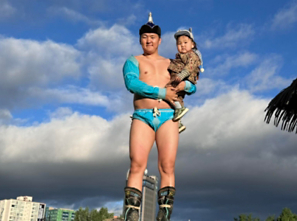
Uugan-Erdene developed a passion for wrestling by watching his father’s prowess in the sport—now he’s passing the torch onto his own son.
Uugan-Erdene learned a thing or two from his old man—it was his father’s trick that would help him put on an impressive performance during 2015’s Nadaam Festival: "2015 was my best year in wrestling. I advanced to the third round in the village Naadam. In the first round, I faced the Falcon of Soum, and after 30 minutes of wrestling, I won. In the second round, I used my father's trick and secured another win. It was a memorable moment for both me and my father."
In recent years, Mongolian wrestling has evolved, making it more challenging to put on a winning display like Uugan-Erdene's in 2015—particularly due to nutritional advancements. "The significance of Mongolian wrestling is its absence of weight classes," Uugan-Erdene noted. "In the past, wrestlers were typically thin, fit, and agile. However, modern exposure to sports supplements and diverse diets has led some wrestlers to become excessively heavy, reducing mobility and making them difficult to defeat. I believe implementing weight limits in Mongolian wrestling would promote agility and enhance the competitiveness of the sport."
Nonetheless—with roots tracing back millennia and a global impact that reverberates through various wrestling styles—Mongolian wrestling remains a vital link to the country's past and a source of national pride: "It is one of the most ancient wrestling styles, and many different styles may have originated from Mongolian wrestling," Uugan-Erdene explained. "Rock engravings depicting wrestling date back to the late Bronze Age, approximately 2500 years ago." He also cited the success of Mongolian wrestlers in Japanese Sumo: "Mongolian wrestlers excel in burst and explosive strength, which aligns well with the Sumo wrestling style perfectly. Over the last 20 years, Mongolian wrestlers have achieved remarkable success in Sumo wrestling in Japan."
With the arrival of each Naadam Festival, the echoes of ancient traditions reverberate across Mongolia's vast steppes and serve as a bridge between generations—connecting modern Mongolians to their nomadic roots. Through the dedication of individuals like Uugan-Erdene Khurtsgerel, this time-honored sport will inspire and unite Mongolians for generations to come.
Embark on our Mongolia & the Gobi Desert adventure to experience Mongolia’s Naadam Festival and observe Mongolian wrestling firsthand.


