
Celso Cardenas, Trip Experience Leader for Machu Picchu & the Galápagos, grew up running in the mountains of Ecuador. Below, he shares insight about the “land of volcanoes,” including tips on traveling at altitude.
Celso Cardenas, Trip Experience Leader for Machu Picchu & the Galápagos, grew up running in the mountains of Ecuador. Below, he shares insight about the “land of volcanoes,” including tips on traveling at altitude.
Trip Experience Leader Celso Cardenas lives—and runs—about 90 minutes southeast of Quito. But Ecuador’s capital has its own share of mountain views, including the only volcano in the world within the borders of a capital city. "Quito is located in the northern highlands of Ecuador," Celso says. "It was built on a long plateau on the east flanks of Pichincha volcano—and six other volcanoes surround the city."
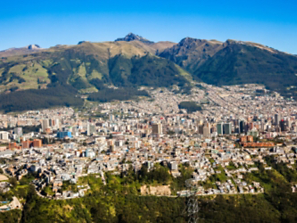
Pichincha last erupted in 2002, causing earthquakes and tremors but no damage or fatalities. In fact, the vast majority of volcanic eruptions pose little to no danger to humans—though that doesn’t mean Ecuadorians shouldn’t stay on their toes. "Ecuador is the land of volcanos," says Celso, "and Quito is in the heart of what we call ‘the Avenue of Volcanos.’"
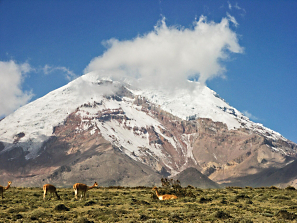
As long as the sleeping giants lay dormant, the visual impact on the landscape is striking—both within Quito and throughout the country. "With luck, I am able to show travelers Ecuador’s highest volcano, Chimborazo, from the main road," Celso says. While its height is nearly 9,000 feet lower than Everest, the peak of Chimborazo is both farthest from the center of Earth and closest to the sun. This is due to Ecuador’s location on the equator—where the Earth bulges in diameter, making nearby mountains farther away from its core.
While it’s true that a quiet volcano is the safest volcano, minor eruptions can be a treat for travelers—both in mainland Ecuador and on the Galápagos Islands, which has its own fair share of mountains, located on a separate tectonic plate from Quito. "The Galápagos is in a hot spot on the Nazca tectonic plate," Celso explains, "while continental South America is on the South American tectonic plate. The Andes, including Quito, are the result of the Nazca plate sliding under the South American."
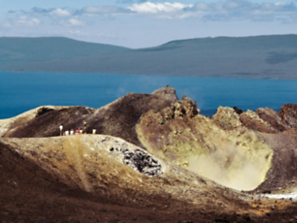
Within the Galápagos, Isabela Island has six volcanoes, three of which are still active—the most of any island in the archipelago. As a result, this is where travelers are likely to see eruptions from a distance. But Celso’s favorite volcanic island is Bartolome (Bartholomew), home to the distinctive Pinnacle Rock. The barren, otherworldly landscape is a fascinating backdrop for hiking.
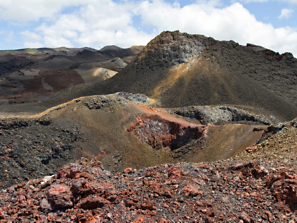
Most recently, several of Celso’s groups were fortunate to view the eruption of El Reventador volcano during the Amazon portion of Ultimate Galápagos Exploration & Ecuador’s Amazon Wilds. "On our last afternoon in the Amazon, I took them to a sandbar along the Napo River, where we sat and waited for the sunset," he says. "If it is clear, we can see the eruption from there in the far distance."
As for his travelers’ reactions? "Oh, they get very excited," he says. "They can’t believe they can see it from the Amazon. There are lots of pictures, hugs, and toasts with wine."
Because a city in the mountains naturally comes with altitude, Celso has advice for Ultimate Galápagos Exploration travelers on first arrival in Quito, located at 9,300 feet above sea level. "Many come one day early to help acclimate," he says. "I also advise drinking lots of water, practicing breathing exercises, and bringing altitude medication." (During Machu Picchu & the Galápagos, travelers arrive in Quito already acclimated from Cuzco, Peru, which is even higher at 11,000 feet.)
As a native Ecuadorian, of course, Celso has no issues with altitude. But the mountains aren’t the only place he runs, even when on tour. "Every day, I get up very early to train," he says. "Even in the jungle."
Witness the dramatic volcanic landscape of Ecuador as well as the Andes Mountains of Peru during Machu Picchu & the Galápagos.
Heavenly Valley
What did the ancient Incas see reflected in the waters of the Urubamba River in Peru’s Sacred Valley?
Hairless Heirlooms
What country's hairless canine is both an ancient breed and living national treasure?
String Theory
What ancient civilization with no written language used "quipus," an intricate system of knotted strings, as a form of communication to rule over their vast empire?
Get The Inside Scoop On...
Like what you see here? Receive weekly updates right in your inbox.
inside-scoopArticles In This Edition

Autumn Leaving: Top 10 Most Popular Fall Journeys

Avenue of Volcanoes, Middle of the World

Climbing to Khufu: Bending to Eternity Inside the Great Pyramid

From the Matterhorn to Mordor

Putting Education Within Reach for Sherpa Students

Social Climber