
Okavango Delta, one of the Seven Natural Wonders of Africa. Experience the beauty of the Africa’s rivers and waterfalls on Ultimate Africa: Botswana, Zambia & Zimbabwe Safari.
Our Biggest Sale of the Year is Here
Okavango Delta, one of the Seven Natural Wonders of Africa. Experience the beauty of the Africa’s rivers and waterfalls on Ultimate Africa: Botswana, Zambia & Zimbabwe Safari.
The Delta and the Deluge
Dusky images of the savannah fill our collective fantasies of the ideal African safari. But in the southern part of the continent, another, more fluid motif emerges: Water. This element is more than just a driving force behind impressive wildlife concentrations—it’s a bona fide phenomenon, a reason to visit in and of itself. Two of the region’s most famous destinations—the Okavango Delta in Botswana and Victoria Falls on the Zimbabwe-Zambia border—each represent the culmination of a wild, watery journey. Join us as we follow the flow—and prepare to get wet!
Southern Africa's Watery Wonders
If you close your eyes and imagine Africa, do iconic images come to mind? An acacia tree silhouetted against a blazing sunset, as an elephant stirs up a cloud of dust, the plains with a hue of burnished gold, a solitary oryx scaling a desert dune, its footprints lingering only momentarily on the shifting sands. Yes, the continent is rife with scenes of windswept, desolate beauty—so pristine, so expansive, so dry.
Of course, this is just one of Africa’s many facets—one that belies the prevalence of water on the continent. On a single African game drive you might snap a photo that resembles the image above—then, a mere half-hour later, come upon a watering hole that plays host to wallowing hippos, wading shorebirds, or countless other thirsty species. The appearance and disappearance of water has shaped the face of Africa for eons; it’s likely that the search for wetter pastures prompted a mass migration of our early human ancestors just as it drives the animals to this day.
Okavango: The Delta in the Desert
The source of Botswana’s Okavango Delta is a river known as the Cubango, which originates nearly a thousand miles north of Botswana in the highlands of Angola. From here, it flows southeast into Namibia and becomes the Kavango River. Upon entering Botswana, it receives its most famous name—and begins its famous transformation. As the Okavango River flows over a series of fault lines that lie deep beneath the surface of the Kalahari Desert, it splits into smaller channels and spreads into the delta’s characteristic fan-like shape, meandering outward in a maze of rivulets until it disappears—as if by magic—into the Kalahari sands.
It’s a river without an ocean—a road that leads to nowhere, in a way. But this hasn’t always been the case. Millions of years ago, the Okavango River flowed unimpeded through the area now occupied by the delta, ultimately meeting a large inland lake and perhaps even reaching all the way to the Indian Ocean. As tectonic activity changed the continent’s topography, however, a natural dam disrupted the flow of the Okavango. It began to disperse into a fertile alluvial plain because it had nowhere else to go.
As one of the largest inland deltas in the world, the Okavango already ranks as a truly unique place—but the seasonal ebb and flow of its waters elevates it to a natural phenomenon. The annual rains fall on southern Africa between November and April, with the heaviest occurring between December and March. This is true both in Botswana and in Angola, where the delta’s headwaters originate. The rainy season infuses the Okavango landscape with a lush, verdant beauty—yet the delta itself typically isn’t flooded at this point. Way up north, the rainwater that swelled the banks of the Cubango River has only just begun its long journey southward—which is just as well, as the Okavango wildlife has plenty of water to sustain itself for now. The floods, in an impressive display of natural timing won’t arrive until the region needs them most.
The delta has gravity—or the lack thereof—to thank for this delay. Over the course of the flood’s 1,000-mile journey, the riverbed elevation never decreases by more than 215 feet, so there’s little force to help move it along. As a result, the water doesn’t reach the southernmost part of the delta until between May and July—several months after the rains first begin in Angola and right in the middle of Botswana’s dry season.
So while wildlife elsewhere in southern Africa begins a struggle for survival during the annual drought, the animals of the Okavango enjoy a second wave of plentitude, with ample grass for grazing and water for drinking. Safari-goers can spot all of Africa’s usual suspects at this time of year—elephant, giraffe, zebra, buffalo, and warthog—as well as less widespread species that are especially fond of the water, like hippo, crocodile, and the aquatic red lechwe and sitatunga antelopes. In many years, animals concentrate around the remaining water sources, and predators like lion, leopard, and cheetah lie in wait nearby.
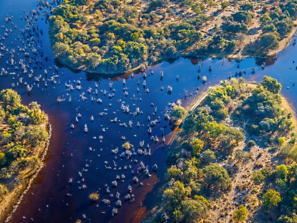
The Okavango Delta from above.
For travelers, though, it’s not just about what to see—it’s also about how to see it. Dugout canoes called mokoro, traditionally carved from local trees but now often made from fiberglass to prevent deforestation, were designed especially for navigating the delta during flood season. An experienced guide poles the mokoro through reedlined waterways, keeping a lookout for myriad animals and birds that can be viewed from a safe distance. It’s one of the most romantic ways to explore the wilds of Africa, gliding almost silently through the stillness of the shallows. (Keep in mind, though, that the delta is unpredictable at any time of year and that water and safety levels must be evaluated before setting out by mokoro.)
To the northeast of the delta, on the border between Zimbabwe and Zambia, another great river transforms its surroundings during the endless cycle of flood and famine. But while the waters of the Okavango Delta are characterized by slow movement and a peaceful ambiance, our next watery wonderland couldn’t be more different.
Victoria Falls: The Smoke That Thunders
In 1855, during an expedition through Africa’s interior, Scottish missionary David Livingstone heard legends of an astonishing sight—Mosi-oa-Tunya, local Tonga people called it, or, “the smoke that thunders.” Intrigued, Livingstone and his party set out by canoe on the Zambezi River to see it for themselves—and they were still miles away when they heard the roar of the water. Livingstone famously wrote in his diary of his first glimpse of the natural wonder: “No one can imagine the beauty of the view from anything witnessed in England ... scenes so lovely must have been gazed upon by angels in their flight.” As the first European to see the falls, he chose a namesake befitting their grandeur: Queen Victoria of England.
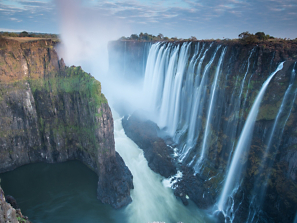
Morning light at Victoria Falls from Zambia looking into Zimbabwe.
Upon encountering Victoria Falls for the first time, it’s easy to understand why Livingstone was so inspired. No other waterfall offers such an unimpeded, head-on view of its thundering spectacle. The Zambezi River flows over a flat plateau for hundreds of miles before plunging down over a sheer, 360-foot gorge. The southern lip of this gorge directly faces the waterfall itself, resulting in a breathtaking natural overlook.
The dramatic suddenness of the waterfall’s plunge amidst such a level, uneventful expanse of land prompted Livingstone to erroneously purport that the falls were created by one cataclysmic geological event—but actually, the process was much more gradual. Geologists believe that earth movement changed the course of the Zambezi over hundreds of thousands of years and that the basalt plateau became intermingled with softer types of rocks that eroded rapidly against the force of the water. The resulting cataracts have receded upstream—leaving stunning gorges in their wake that still stand in silent testament to the river’s ever-shifting path.
Given this superb setting, it hardly seems necessary to split hairs over whether Victoria Falls—a UNESCO World Heritage Site often counted among the natural wonders of the world—is actually the world’s largest. Yet comparisons abound between Victoria and other famous cascades, citing an array of criteria. For example, Victoria Falls easily dwarfs Niagara in both height and width, but Brazil’s Iguassu Falls is technically even wider. Iguassu, however, is comprised of several smaller waterfalls as opposed to Victoria’s massive, unbroken deluge. So it is generally accepted that Victoria Falls reigns victorious as the largest curtain of water in the world.
The curtain is typically most impressive during the Zambezi’s annual flood season, which usually peaks between roughly March and May. Water levels vary considerably from year to year, so flow at any given time can differ from the typical pattern. At peak water levels, the spray from the falls reaches a typical height of 1,300 feet—and sometimes even higher. Vivid rainbows add to the “wow” factor here, but remember: if you visit during these months, staying dry isn’t an option. You’ll need to don slickers, though getting wet can be part of the fun (provided you keep your camera safe). But don’t be discouraged from visiting during the drier months, or in a lower-water year. While the deluge won’t thunder quite as powerfully, the smaller cascades allow for better views of the falls’ craggy gorges, and a closer approach is possible without getting soaked.
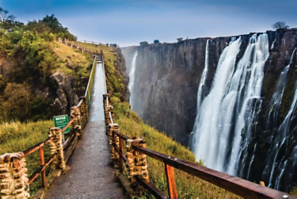
Victora Falls, from the Zambian side.
At any time of year, the spray from the falls is plentiful enough to nurture a narrow band of lush vegetation—technically not a “rain forest,” but verdant and beautiful enough to warrant the general use of the term. A stroll around the falls from one lookout point to the next is made all the more enjoyable by this forest canopy, replete with ivory and date palms, creepers, lianas, and ferns. Vervet monkeys and baboons are frequent visitors along the paths leading to the falls, and hundreds of bird species flock to this perpetually moist microcosm. Kingfishers, bee-eaters, hornbills, and ibis descend upon the forest vegetation, while majestic raptors like eagles, buzzards, and falcons patrol the skies above the gorges.
When you’re faced with the power of Victoria Falls, though, it’s likely that you’ll hardly even notice the birds flitting above you—just as you could spend hours happily meandering in a mokoro on the Okavango Delta before realizing whether the hippos had other places to be that day. And that’s quite alright. After all, you’ll have plenty of other opportunities on safari to track herds of animals over starkly beautiful plains. When it comes to the delta and the deluge, the waterscapes have a wild life all their own—and they’ll demand every drop of your attention.
Explore the Okavango Delta by mokoro (traditional canoe) on Ultimate Africa: Botswana, Zambia & Zimbabwe Safari.
Running Wild
If you ever found yourself being chased by wildlife in the African Serengeti, which one of these animals would catch you first?
Africa, Primordial: A Journey Back to the Beginning
It was her husband’s dream, but not necessarily hers. What happened when she left her comfort zone?
Elephant in the Room
Read about how 12-time traveler Don had a very close encounter with an elephant in Zimbabwe.
Get The Inside Scoop On...
Like what you see here? Receive weekly updates right in your inbox.
inside-scoopArticles In This Edition

Animal House

Costa Rica: Wet, Wild, Wonderful

Disappearing Fast: Top 10 2027 Journeys with Single Space Still Available

From Oregon to Oslo: Facing Fear, Finding Family in Norway

Highly Recommended: Top 15 Adventures Shared With New O.A.T. Travelers

Legacy of a Leader: Sir Edmund Hillary and Grand Circle Foundation

Perfectly Imperfect

Rock the Kasbah