
At Buddhist temples, each prayer wheel contains a mantra, and spinning one helps focus the mind and earn merit for the practitioner.
Howard A. is an Ashland resident, travel photographer, writer, and former high technology executive. He has photographed in 79 countries on six continents and has traveled to 39 of the U.S. states. He is primarily interested in native and tribal cultures, religion, architecture, and wildlife, which he feels are all disappearing at an alarming rate. His goal is to document through photographs and articles as much of this as possible, while it still exists.
By Howard A., 20-time traveler and 10-time Vacation Ambassador from Ashland, MA
The expression that “the only constant is change,” is part of our everyday language, but do we realize how true this is? Impermanence is clearly the most permanent part of our lives. I received my first lesson in how fleeting things are as a boy, when my beautiful Schwinn bicycle was stolen. I was devastated, and cried for weeks. I naively assumed that this was the worst blow that life could ever deal me. My parents were thoughtful people and did not replace it immediately, allowing time for the lesson of impermanence to sink in. It didn’t.
Years later my beloved dog Phaedra died. To me she was irreplaceable, and I had never given much thought to the idea that she was only here for a certain amount of time. I was inconsolable, and grieved for months. As a young adult, I watched my father’s thriving retail business crushed by the new wave of department stores. Our family fell on hard times, and we struggled. This new wave of the dozens of different independent department stores and chains that swept across America would themselves be replaced by malls, and the malls are now being replaced by online retailers. I don’t know what is next, but something will replace online.
When my father passed away I was shattered. By this time I had clearly begun to understand impermanence, but understanding and accepting are not even remotely similar. My mother left this world a few years later. Life was teaching me to accept that nothing lasts. I was a slow learner. With time however, the lesson of impermanence would be learned.
Nothing is permanent. Once rock-solid jobs, are eliminated. Countless occupations become the part of the annals of history. Trees die, flowers die, pets die, and sadly parents, loved ones, and friends are all temporary. As high order creatures, we struggle with this clear, simple, and painfully obvious reality. Why is this? Are we hard-wired in our DNA to try to hold on to everything? Is this part of our primal survival instinct as humans?
In the foothills of the Himalayas in the northeast corner of India near the Chinese border lies the unique village of Dharamshala, in what is referred to as the Tibet Autonomous Region. At almost 7,000 feet in elevation, this area is strikingly beautiful, and vibrantly alive with Buddhist culture. Dharamshala is the Holy City of the Tibetan Buddhists in exile. It is here where Buddhists from Tibet fleeing Chinese oppression, began settling in the 1950s. This unique area of 55,000 mostly Buddhists, is aptly referred to as “Little Lhasa”.
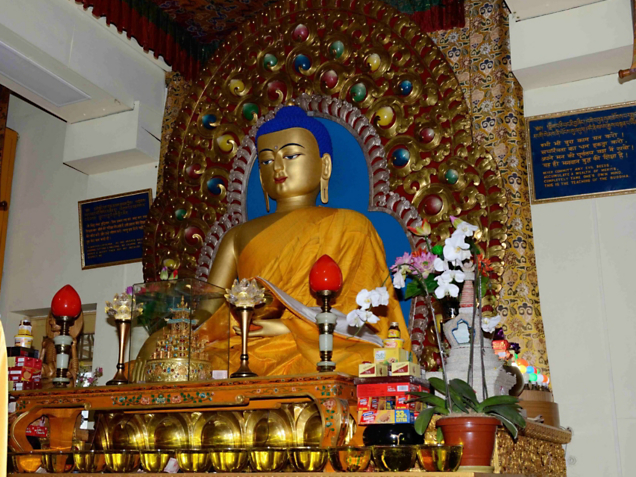
An image of Buddha watches over the Dalai Lama’s sanctuary.
Overseas Adventure Travel took us here as an extension to our recent India tour. We had the opportunity to spend a full morning at the Dalai Lama’s Temple Complex. This is the personal residence, palace in exile, and primary place of worship of His Holiness, when he is not traveling. The complex is colorful, and robustly celebrates life in its vibrant architecture and decorations. Many rows of large prayer wheels abound and strings of prayer flags danced in the cool morning breeze. In this remote place, as a senior citizen, I would once again be reminded of impermanence, this time demonstrated emphatically by Buddhist monks, and in a most unforgettable way.
After a tour of the palace, and meeting with and receiving individual blessings from the senior monks, we entered the Dalai Lama’s private sanctuary. It is a small but beautiful single room, and the large Buddha statue silently overlooking everything puts you immediately at ease. I was struck by the small size and modesty of this place of worship. I doubt that it could comfortably accommodate more than 60 people. You can wander freely, and take in the serenity and beauty that Buddhism offers. Monks in their bright red and gold robes come and go performing their daily activities, as you watch life enacted in the Buddhist way. Your mind is clear and you are totally immersed in the moment. This lucid and “present” state is what Buddhists seek. In the personal sanctuary of His Holiness the 14th Dalai Lama, the leader of over 500 million Buddhists, I would today witness how Buddhists teach and reinforce one of life’s most important lessons. Nothing is permanent. Nothing.
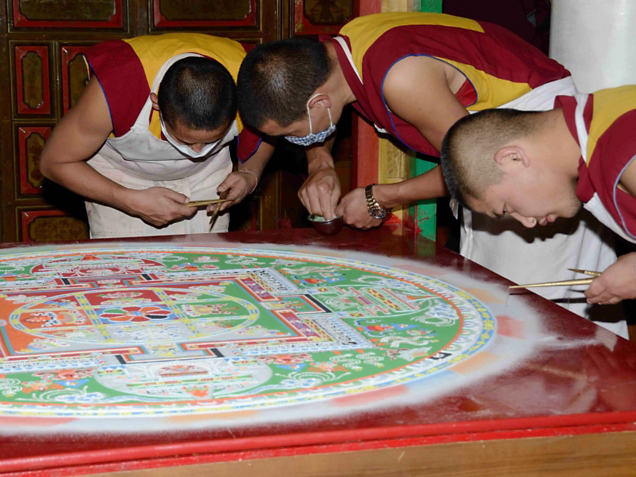
Working in shifts, monks spend thousands of hours meticulously creating patterns from individual grains of sand—only to deliberately destroy them as a lesson in impermanence.
As we watched, one of the most stunning examples of Buddhist rituals unfolded before our eyes. A group of four monks gathered around a four-foot by four-foot wooden board, cinched up their robes, leaned forward, and with long narrow fluted metal tubes scooped up tiny grains of colored sand, and continued work on a large circular sand painting called a mandala. A mandala painting or structure is a circle, or if you prefer a wheel, representing wholeness. It is seen as a model for all life. Its limitless possibilities of geometric patterns are intended to depict our relationship as humans to the present and the infinite to the current moment, as well as the world that extends beyond our physical and “temporary” bodies.
Buddhist monks must first go through years of training to learn the skills required to make a sand mandala. The ritual of the mandala is considered extremely sacred, and cannot be done lightly. As part of spiritual practice in ancient Tibet, monks created intricate mandalas with colored sand. This 1,000-year-old tradition continues to this day, as monks travel the globe to teaching the art of mandalas and educating people about the teachings of Buddha.
I gazed in amazement as the monks worked tirelessly on a beautiful multi-colored and intricately detailed mandala, moving colored sand particles into place with tiny tweezers and pins, one grain at a time. This is mentally laborious and is not easy on the feet or eyes, so the monks work in teams of four, changing shifts throughout the day. Each of these sand mandalas will take one to two months to complete. When finished, the mandala is striking in color and geometric detail, and represents thousands of man-hours of tedious and skillful artistic effort.
The following day the entire monk community of the monastery will gather in a gleeful ceremony where the mandala is blessed. As they chant in unison, and pray over the mandala, with the single stroke of a broom, thousands of hours of intricate work are destroyed in an instant, demonstrating in a most profound fashion how fleeting everything in life is.
This is not an unhappy moment, but in fact a joyous one for the monk community. Buddhists are not an unhappy group. They have received the energy that the mandala had to offer, and for Buddhists “process” is more important than product”. They look at this entire progression beginning with a single grain of colored sand, ending with millions, and destroyed in an instant, as a teachable moment that needs constant repeating. The disassembled sand will be placed in a container and emptied it into a nearby body of flowing water, signifying the infinite cycle of life. The next day, months of teamwork will once again begin with single grain of sand.
Don’t be sad friend. Buddha himself would discourage this. Accept impermanence and live every moment with all the joy it deserves. This is the essence of Buddhism. The miracle of every sunrise is yours to behold. The serenity of every sunset is yours to ponder. Enjoy your material things, but be careful about giving affection to anything that cannot return it. Love everyone you care about with all your heart. We have all heard the expression “One never knows what tomorrow brings.” Perhaps a better way to look at it is “One never knows what tomorrow takes away!”
Everyone and everything is a “limited engagement.” Impermanence is permanent. Don’t overthink it. Accept and rejoice.
Visit Dharamshala with O.A.T. during India’s Sacred Cities of the North: Amritsar & Dharamsala pre-trip extension, part of our India's Sikkim & Bhutan: Hidden Kingdoms of the Himalayas adventure.
Get The Inside Scoop On...
Like what you see here? Receive weekly updates right in your inbox.
inside-scoopArticles In This Edition
