
Travelers on our The Aegean Islands, Athens & Istanbul adventure can muse under a tree in Greece like Aristotle was when he discovered the concept of the camera obscura—the earliest ancestor of modern photography.
Question: Who do many consider to be the inventor of camera obscura—the inspiration for all modern photography?
Answer: Aristotle
The story goes that somewhere around 360 BC, Aristotle was sitting under a tree during a partial eclipse of the sun. No, he wasn’t struck by a falling apple—that would be Newton with his gravity thing. What struck the Greek philosopher and scientist instead, was the principle of the camera obscura.
Writing in Problemata, Aristotle’s collection of questions on various topics, he described how during the eclipse, the sun cast crescent images of itself on the ground at his feet. He wrote how the gaps created by the back-and-forth movement of the leaves acted as pinholes, allowing the sun’s rays to pass through and cast images on the ground.
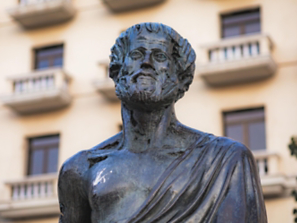
A statue of Aristotle located in Thessaloniki—a Greek port city that O.A.T. travelers visit on our Northern Greece, Albania & North Macedonia: Ancient Lands of Alexander the Great adventure.
He goes on to describe a device he builds to recreate the effect, which consisted of a dark chamber with a single small hole to allow for sunlight to enter. Even if the shape of the hole is square, he observed, the sun is always displayed correctly as a round object. This room-sized pinhole camera he described in Problemata is thought to be the earliest known written evidence of a camera obscura—which is basically the earliest ancestor of modern photography.
Let some light in—and see what develops
So just to be clear, what is meant by a camera obscura is a large room that is completely dark except for small pinhole in one wall. Light comes through the pinhole and projects a scene from outside onto the opposite wall—and due to the nature of optics, the scene is always projected accurately, but upside down. Of course, Aristotle wouldn’t be familiar with the term camera obscura (Latin for "dark chamber"). It would be another thousand years before the phrase was coined by German astronomer Johannes Kepler.
To be fair, though, a few ancient Chinese philosophers and Islamic scholars had also been pondering over the natural optical law behind camera obscura about the time of Aristotle. Regardless, work would continue among scientific communities on the camera obscura over the centuries. Like everything else he touched, Leonardo da Vinci would play an important role in the development of the technology. While writing about flying machines and musical instruments, da Vinci published the first detailed description and drawings of the camera obscura in 1502. His diagrams also revealed how these early image projection techniques could be hugely beneficial to Renaissance artists who wished to study perspective and to help them capture highly detailed elements in their paintings (more on that shortly).
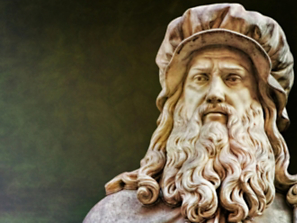
An ancient statue of Leonardo da Vinci in Florence—home to many masterpieces of Renaissance art and architecture—which O.A.T. travelers visit on our Tuscany & Umbria: Rustic Beauty in the Italian Heartland adventure.
In the mid-1500s, glass lenses and mirrors were introduced to camera obscura as a way to direct images into special viewing areas, making them a popular way to view solar eclipses. At the dawn of the 17th century, Kepler (the astronomer mentioned earlier) introduced the first portable camera obscura, which was basically a tent with a sheet of paper inside where the camera’s lens could be projected. Then, camera obscura slowly developed into a popular form of public entertainment—almost like the way we head to the multiplex to catch a Hollywood blockbuster (or used to, anyway). The Victorian era became its real heyday, with room-sized structures being built as tourist attractions along some of the world’s great scenic regions, but especially along the seacoasts of North America and Europe.
Modern photography comes into focus
The age of modern photography really began around 1816, when Joseph Nicéphore Niépce used a camera obscura to expose paper coated in silver nitrate to light—producing what many believe to be the world’s first photographs. The images were blurry and faded quickly, but still ... Unfortunately, Niépce himself faded rather quickly too, dying shortly after he began working with Louis Daguerre. Before his death, Niépce left his notes to Daguerre, though, who was said to have been a bit lacking in the scientific knowledge of the day. Daguerre used Niépce’s notes to continue his own experiments in photography, and he soon found that putting the image in a salt bath "fixes" the image, preventing it from fading, Daguerre named the process daguerreotype, which became an immediate sensation. And as far as photography goes, the rest, as they say, is history.
Now, let’s get back to the use of camera obscura during the Renaissance …
Tracing down an Old Master’s secret
Giovanni Battista Della Porta was an Italian scholar who began advising artists to use the camera obscura to perfect their sketches and paintings—arguing that the device would both enable them to trace their subjects and make their artwork highly realistic. Della Porta wrote that it made it "possible for anyone ignorant in the art of painting to draw with a pencil or pen the image of any object whatsoever." As a result, many artists of the Renaissance did indeed rely on this method to assist in their painting—but they also considered it a form of "cheating" and rarely owned up to it. Kind of a "paint by numbers" if you will.
Which brings us to the story of Jan Vermeer. The 17th-century Dutch Old Master is responsible for some of the world’s most beloved paintings—works that have stunned artists and art historians alike for their photo-realism and use of light, color, and perspective like no painter had done before. But very little is known about him. We still don’t know who he studied with. In his career, he produced fewer than 40 paintings, and he left no drawings, notes, or letters after his death at the age of 43.
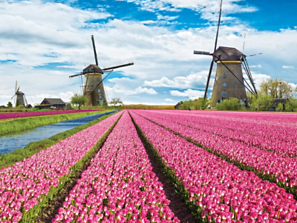
Travelers can walk in the footsteps of the "Dutch Masters" during Grand Circle’s Holland & Belgium in Springtime River Cruise.
It wasn’t until about 250 years after his death that people first began speculating that Vermeer may have used a camera obscura or some similar optical aid to produce his paintings. And over the past century, it seems that art experts and physicists alike are obsessed with answering the question: Did or didn’t Jan Vermeer paint his brilliant pictures with the help of a camera obscura?
The gloves came off in 2001 with the publication of Secret Knowledge: Rediscovering the Lost Techniques of the Old Masters by British pop-artist David Hockney. Hockney hypothesized that optical aids must have played a role in the emergence of realism in Vermeer’s work (and basically in all post-Renaissance Western art, he said). When physicist and optics expert Charles Falco backed him up, the "Hockney-Falco Thesis" was born and swept the art world.
More books and documentary films on Vermeer would follow, with passions running deep on both sides of the issue. Some accused Hockney of simple jealousy because he couldn’t produce realistic art himself. But things got very interesting with the release of a 2014 documentary called Tim’s Vermeer. Produced by Penn Jillette (yes, of Penn & Teller fame), the film chronicles how Texas inventor (and non-artist) Tim Jenison built a camera obscura that would have been available during the Dutch Renaissance to recreate a painting by Vermeer. He decided on The Music Lesson, a painting of a girl at a harpsichord with her male teacher standing at her side. To reproduce the painting with the help of a camera obscura, Jenison builds an exact reproduction of the room in Vermeer’s original painting. Then, using pigments only available in the late 1600s, he spends about 220 hours slowly painting, millimeter by millimeter, only what he sees in his mirror. The results of his efforts? You’ll have to judge for yourself—but most would say quite astonishing.
Still, the mainstream art establishment remained unconvinced, insisting Vermeer had no help. The most they will say is that perhaps he was inspired by lens-projected images. But even if he was, they say, it takes nothing away from his otherworldly genius. One has to wonder what Aristotle would make of all the trouble his camera obscura has caused …
Yes, you can still visit a working camera obscura—here are five of them:
Visit Aristotle’s homeland and find a tree to muse under during O.A.T.’s The Aegean Islands, Athens & Istanbul adventure.
A Blessing in Disguise
In what country is spitting at the bride and groom as they walk down the aisle considered good luck?
Cult Classic
What creature did the ancient Greeks associate with longevity, health, and wellness–one that has become a universal symbol of healing?
Get The Inside Scoop On...
Like what you see here? Receive weekly updates right in your inbox.
inside-scoopArticles In This Edition

A Traveler’s Confession

Focus Group

NEW Adventure: Argentina & Chile's Rugged North: From the Andes to the Atacama Desert

Take Your Best Shots: Tips for Shooting Video & Photos