Join Astra Petkunaite—Trip Experience Leader for The Baltic Capitals—for a peek inside Vilnius’ Lithuanian Song and Dance Festival, a century-old celebration of Lithuanian folk culture where locals are costumed in traditional dress, and a song can be heard on every corner of the nation’s capital.
As Astra explains in her video above, song-and-dance festivals throughout the Baltic states symbolize more than just a celebration of culture. During the Soviet era, traditional folk music evolved from a form of subtle political protest into a catalyst for revolution. Today, these festivals—held every four years in Lithuania and every five years in Estonia and Latvia—are recognized on UNESCO’s Intangible Cultural Heritage List.
The “Singing Revolution:” Tallinn’s peaceful protest
Between the years of 1987 and 1991, yearning to shake off the yoke of Soviet rule, the Baltic people began to engage in a series of public singing demonstrations—often chanting national anthems and cherished folk songs. Soviet officials discouraged these patriotic sing-alongs, wanting to unify disparate populations under the USSR umbrella. As these once-localized musical outbursts became larger and more fervent, the voices of the Baltic people echoed all the way to the highest offices of the Soviets.
On September 11, 1988, approximately 300,000 people gathered at the Tallin Song Festival Arena to sing national songs and hymns, while rock musicians supported and encouraged them onstage. More than a quarter of the entire Estonian population was in attendance—how’s that for unity? Song festivals continue to be popular across all three Baltic countries, beloved as a way to champion national identity and help preserve the past.
Chain of Freedom: peaceful protest or “nationalist hysteria”?
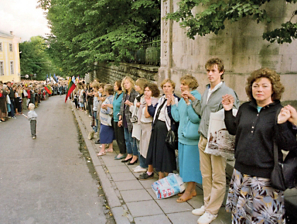
In 1982, two million residents formed a 400-mile human chain from Tallinn to Vilnius to protest the 1939 pact that allowed Russia to annex the Baltic States.
As it turned out, the Singing Revolution was only the beginning of a march towards democracy. On August 23, 1989, an estimated two million Baltic people all joined hands to physically and symbolically link their three capital cities of Vilnius, Lithuania; Riga, Latvia; and Tallinn, Estonia. This human chain—referred to as the “Baltic Way” or, more locally, “Chain of Freedom”—extended over a length that exceeded 400 miles. While this may sound like a feat straight out of the Guinness Book of World Records, the message was serious: It was an expression of joint solidarity against decades of Soviet rule. The year of the chain marked the 50th anniversary of the Molotov-Ribbentrop pact that annexed the Baltic States to the USSR. A growing number of activists, eager to bring the issue of illegal Soviet occupation to the world stage, organized the human chain.
Each state had its own pro-independence movement to help coordinate the effort: the Popular Front of Estonia (Rahvarinne), the Popular Front of Latvia (Latvijas Tautas Fronte), and the Reform Movement in Lithuania (Sajudis). Local support was encouraging; thousands of signatures had been gathered in multiple petitions, and organizers provided free bus transportation to ensure an unbroken chain in rural areas. Estonia declared the day to be a public holiday, and many businesses closed to allow employee participation. Aided by radio broadcasts to help organize the massive demonstration, the participants joined hands for 15 minutes.
Although it would take an additional two years of diplomatic and political victories, the Chain of Freedom was ultimately successful: Lithuania, Latvia, and Estonia were recognized as independent states by the end of 1991.
Learn about the fight for freedom and ensuing cultural resurgence in these nations during The Baltic Capitals.


