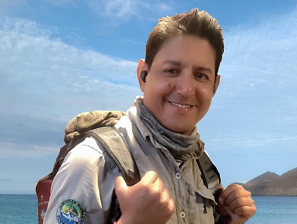
Roberto Peralvo— a Trip Experience Leader for O.A.T.’s Machu Picchu & the Galápagos adventure—told the Inside Scoop, "The Galápagos Islands are a treasure trove of unique wildlife and ecosystems, offering unparalleled experiences for both naturalists and visitors."
From the mist-shrouded peaks of the Andes to the volcanic shores of the Pacific, our Machu Picchu & the Galápagos adventure beckons travelers on an extraordinary odyssey through South America's most awe-inspiring destinations. Roberto Peralvo and Ciro Villavicencio are stewards of these remarkable lands and serve as O.A.T. Trip Experience Leaders for the Machu Picchu & the Galápagos adventure. While Roberto runs the Galápagos segment of the adventure, Ciro guides travelers through the Peruvian portion of the trip. Passionate about their homelands, they eagerly shared their intimate knowledge and personal stories with the Inside Scoop, aiming to inspire greater awareness and commitment to the preservation of unique cultures and ecosystems.
For Roberto, the Galápagos is more than just a paradise—it's home. Roberto grew up on the islands without electricity, and his father would read adventure stories by candlelight, igniting his passion for nature and travel: "I still remember the first time my dad read to us at night by candlelight, 20,000 Leagues Under the Sea," he shared. "The more my dad read the book aloud, the more my imagination kept creating every scene of this incredible book. I believe that these types of adventures were always in my subconscious and created the urge to travel and enjoy the outdoors."
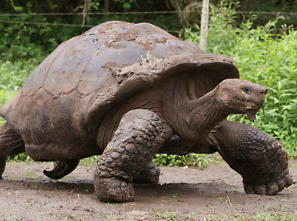
Galápagos tortoises can live up to 177 years—that means some alive today may have hatched before the American Civil War!
Soon enough, Roberto’s early fascination with adventure and nature blossomed into a deep appreciation for the Galápagos' unique ecosystem: "The Galápagos Islands are a treasure trove of unique wildlife and ecosystems, offering unparalleled experiences for naturalists and visitors alike," he explained. Indeed, the archipelago—located about 600 miles off the coast of Ecuador—is renowned for its high level of endemism, with many species found nowhere else on Earth. Iconic examples include the Galápagos tortoise, with its massive shell and long lifespan, and the marine iguana, the world's only sea-going lizard.
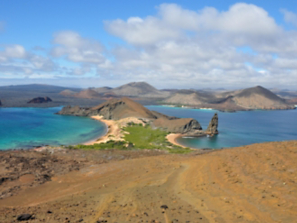
The area surrounding Pinnacle Rock is an Eden for marine wildlife.
The islands' remote location and relatively recent human habitation have allowed their ecosystems to remain remarkably well-preserved. "The islands provide a snapshot of nature in a largely undisturbed state, allowing for the study of natural processes with minimal human impact," Roberto noted. This pristine environment—combined with diverse habitats ranging from volcanic landscapes to lush highlands and coastal mangroves—creates an invaluable natural laboratory for studying evolutionary biology and ecology.
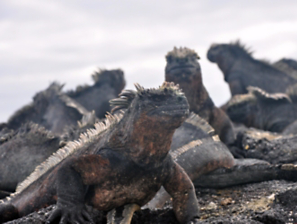
The marine iguanas of the Galápagos are the only sea-going lizards in the world (and a personal favorite of Roberto’s).
Among the fascinating creatures of the Galápagos, Roberto is particularly fond of the marine iguana. "Marine iguanas are incredibly unique as they are the only sea-going lizards in the entire world!" he enthused. These remarkable animals have adapted to ocean life, capable of diving up to 80 feet deep and staying submerged for over ten minutes to feed on algae. Roberto added, "They can sneeze out salt through their nostrils—a nifty trick to imagine! So, while they may not be fire-breathing dragons, they certainly are salt-sneezing ones!" This adaptation allows them to expel excess salt ingested while feeding—a crucial survival mechanism in their marine environment.
The Quechua People: Guardians of Nature in the Peruvian Andes
While the Galápagos offers a glimpse of nature largely untouched by human influence, the adventure's journey to Peru provides insight into the enduring traditions of the indigenous Quechua people. Ciro emphasized the deep connection between Quechua culture and the natural world, a relationship that has been cultivated over thousands of years.
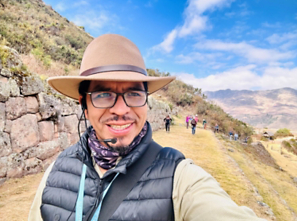
Ciro Villavicencio guides travelers through the Peruvian portion of O.A.T.’s Machu Picchu & the Galápagos adventure.
"The Quechua traditional practices are always in harmony with nature, so everything is related to nature and environmental protection," Ciro explained. This holistic approach to life and the environment is deeply ingrained in Quechua culture. "They don't use chemical pesticides; a number of communities use natural products as fertilizers. They protect the water sources and use it thinking about the next generations." This sustainable approach to agriculture and resource management has allowed the Quechua to maintain their way of life in the challenging Andean environment for centuries.
Conservation Challenges in Fragile Ecosystems
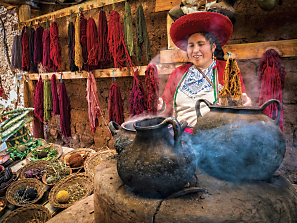
In the ancient city of Chinchero, Peru, the native people still speak Quechua and make natural colored textiles.
Both destinations face significant environmental challenges in the modern era. In the Galápagos, Roberto pointed out threats from invasive species, climate change, and the pressures of tourism. Introduced plants and animals—such as goats and rats—have disrupted native ecosystems, while rising sea temperatures associated with climate change are affecting marine life. Meanwhile, Ciro highlighted the challenges facing Quechua communities: "There are some areas in the mountains as in the rain forest threatened by projects related to mining or development, creating deforestation and affecting the water." These pressures from modernization and resource extraction are putting stress on traditional Quechua ways of life and their ancestral lands.
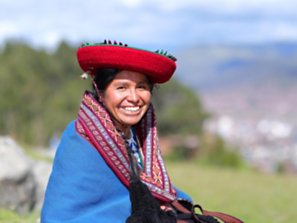
Montera is a Quechua word for a traditional hat, which varies in style depending on the region.
Fortunately, conservation efforts are ongoing in both regions to address these challenges. In the Galápagos, Roberto cited recent successes—such as the eradication of invasive rats from certain islands using innovative drone technology. This project, initiated in 2019, has shown promising results in protecting native bird species and their eggs from predation. In Peru, Ciro noted that "Peruvian administration plays an important role creating law and regulations to preserve Quechua and native land. Peru has many important national parks to protect and preserve nature and local people itself."
Responsible Tourism: Exploring Without Exploiting
Tourism plays a significant role in both areas, bringing economic benefits—but also potential environmental impacts. In the Galápagos, measures are in place to ensure sustainable travel—including visitor limits, strict regulations on tour operators, and designated visitor sites to minimize impact on wildlife. Roberto advises travelers to use reusable water bottles and minimize waste to help protect the fragile ecosystem. "Every small action counts," he emphasized. "By being mindful of our impact, we can help preserve this unique environment for future generations."
In Peru, tourism is being harnessed as a tool for cultural preservation and economic development. Ciro described how this works in practice: "In Cusco state, there are a number of communities participating in tourism initiatives, offering community tours where they show visitors their homes and share traditions such as local cuisine and farming activities. This helps them preserve their land while also providing an opportunity to earn extra income."
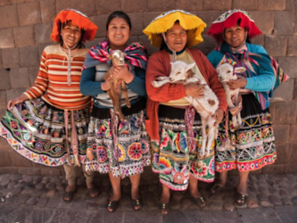
Quechua women show their traditional dresses in Cusco, Peru.
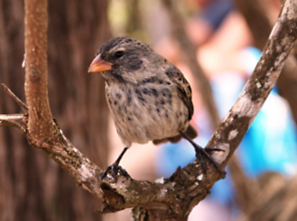
Both guides emphasized the importance of responsible travel. Roberto encouraged visitors to the Galápagos to come with an open mind and respect for the environment, suggesting that travelers take time to observe and appreciate the subtle interactions between species and their environment. After all, the Galápagos Islands continue to serve as a living laboratory for studying evolution and adaptation: Roberto highlighted ongoing research on Darwin's finches, describing the work of Peter and Rosemary Grant, who have studied these birds for decades on the island of Daphne Major. Their research has shown how rapidly natural selection can act in response to environmental changes, providing real-time evidence of evolutionary processes.
On the Galápagos island of Daphne Major, Peter and Rosemary Grant conducted decades-long studies of Darwin's finches—compiling remarkable evidence of evolution in action.
Likewise, Ciro added, "Travelers should know Quechua people are still attached to their roots related to spiritual beliefs, making them have a deep respect for nature and they work hard to protect Pachamama (Mother Nature)." Ciro encouraged visitors to approach Quechua communities with respect and openness, ready to learn from their deep wisdom and connection to the land. These indigenous people maintain their ancient knowledge and sustainable practices, offering valuable lessons in harmonious coexistence with nature that have been honed over millennia in the challenging Andean environment. Ciro explained how Quechua agricultural techniques—such as terracing and crop rotation—have allowed for sustainable farming in the challenging Andean environment for centuries. These practices, he noted, are gaining renewed interest in the face of global climate change and food security concerns.
Quechua women weaving blankets in the Andes.
As our planet faces unprecedented environmental challenges, the lessons learned from the Galápagos and the Quechua people resonate more powerfully than ever. Roberto and Ciro's stories remind us that every journey has the potential to transform not only the traveler but also the places and people we encounter. And that’s exactly why our Machu Picchu & the Galápagos adventure offers more than stunning vistas and unique wildlife encounters—it presents an opportunity to witness firsthand the delicate dance between preservation and progress, between ancient traditions and modern challenges. In the end, we are reminded that the true essence of travel lies not just in the destinations we visit, but in how those experiences change us and empower us to change the world for the better.
Spend a Day in the Life alongside the Quechua people in rural Peru and, later, visit the Galápagos during our Machu Picchu & the Galápagos adventure.